
Last night, I fell down one of those delightful internet rabbit holes. It started with a short TikTok from History Mystery Man, the historical storyteller who specializes in lost racetracks and forgotten places. In the video, he mentioned an abandoned speedway “hidden in the woods north of Jackson, Michigan.” As soon as I heard “north of Jackson,” my educator brain and my local‑history curiosity both lit up. Where exactly was this place?
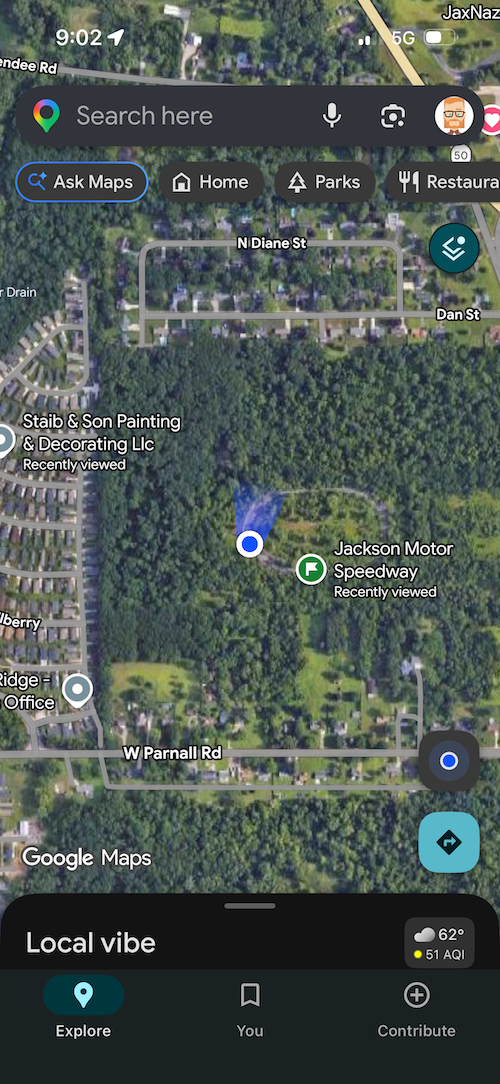
I pulled up Perplexity and started digging. Within a few minutes, I had an approximate address and satellite imagery for the old Jackson Motor Speedway: a ghost track sitting just west of US‑127, about two miles north of downtown, tucked back in the trees near Clinton Way. When I realized that this legendary racetrack had been sitting literally a couple miles from my house in Jackson, I just sat back in my chair, stunned. Somehow, a piece of Michigan’s racing heritage—and my own family story—had been hiding in plain sight.
Racing in the Family
To be clear: I’m not a “car guy” in the way my grandfather, my dad, and my uncle were. I can appreciate a beautiful machine, but I don’t live for horsepower specs or race schedules. Still, racing runs deep in my family’s bloodstream.
My grandfather and my dad grew up in the era when Jackson Motor Speedway was in its prime—late 1940s through the 1960s—when the half‑mile high‑banked dirt oval and later its shorter, unusual paved configuration drew huge crowds on summer nights. Back then, this wasn’t just local entertainment; it was part of a broader outgrowth of Michigan’s automotive story. The industrial genius that put the world on wheels also gave rise to a culture of speed, risk, and competition, and small tracks like Jackson became breeding grounds for drivers who would go on to run at places like the Indy 500.
So when I realized that this “legendary racetrack hidden in the woods” was not just somewhere in mid‑Michigan but essentially in my neighborhood, it felt strangely personal—like discovering a forgotten chapter of my family’s biography carved into the landscape.
From Screen to Soil
The more I watched, the more I wanted to go see it for myself. History Mystery Man’s YouTube video on Jackson Motor Speedway gives a haunting, detail‑rich walk‑through: the opening in 1948 under the Stull family, the later paving that changed the character of the track, the slow decline amid competition from Michigan International Speedway, and the sobering tally of seven lives lost on those high banks.
This morning, curiosity got the better of me. I drove up 127, turned off near the old address, and circled around until I found a spot that looked like a reasonable point of entry—no “No Trespassing” signs, just a quiet stretch of woods. I parked, stepped into the trees, and followed a faint path. Within minutes, the forest opened up, and there it was.
The oval was still there: cracked pavement, weeds and saplings pushing through, berms softened by decades of weather. I walked up onto the banking and started around the track. It’s surreal to stand on asphalt that once carried roaring fields of stock cars and open‑wheel machines, now silenced except for birds and wind. Knowing that thousands of people once filled the stands and that some never came home from this place made the quiet feel thick, almost reverent.
Appreciating What I Don’t “Do”
Even though I’m not personally immersed in motorsports, walking that track crystallized something for me about appreciating what others love. I don’t have memories of Saturday nights at Jackson Motor Speedway, but my father and grandfather did. For them—and for countless families across mid‑Michigan—this was more than a hobby. It was community, ritual, and identity.
As someone who spends his days thinking about learning, narrative, and human flourishing, I find it moving that a seemingly niche interest like local auto racing can be a deep well of meaning: shared risk, craftsmanship, camaraderie, and the simple joy of speed. Finding this ghost track reminded me that honoring the passions of the people we love is one way we honor them—and that the landscapes around us are often holding our stories long after we’ve forgotten where they were written.
A Hidden Classroom
From an educator’s perspective, Jackson Motor Speedway is a ready‑made “hidden classroom.” It’s a site where you can talk about:
- The history of the automobile industry and its cultural outgrowths.
- Risk, safety, and community memory, including the very real lives lost here.
- How places transition from hubs of activity to abandoned sites, and how narratives like History Mystery Man’s help keep them from disappearing entirely.
Last night, a TikTok nudge and an AI search turned into a short pilgrimage: from a glowing screen, to a map, to a quiet walk on an overgrown oval hidden in the woods. It left me grateful—not just for the tools that helped me find it, but for the invisible threads that tie global histories, local landscapes, and family stories together in ways we often only notice by accident.
