Designing for Engagement, Designing for Connection

Caroline Chance’s recent Online Learning Consortium article, “From Isolation to Connection: Practical Approaches to Minimize Loneliness Among Students in Digital Classrooms,” resonates strongly with the questions at the center of my dissertation research. Chance argues that loneliness is not an inevitable feature of online learning. Through intentional course design, meaningful interaction, instructor presence, and institutional support, online environments can become places of genuine connection.

My research approaches this broader conversation from a different direction. I am examining how LMS-based behavioral engagement metrics differ descriptively between students enrolled in Quality Matters-certified and non-QM online sections of the same course. While Chance focuses on loneliness, belonging, and connection, my study focuses on observable student behaviors within the learning management system. Both begin with a similar premise: course design matters, and its effects may become visible in how students participate in an online course.

Where the Article and My Research Connect

One of the clearest connections is the emphasis on intentionality. Chance describes instructor presence, transparent course structure, early low-stakes interaction, purposeful discussion, and well-supported collaboration as design choices that can help students feel that they belong. These practices overlap with principles embedded in the Quality Matters framework, particularly clear navigation, alignment, learner interaction, support, accessibility, and transparency.

The article also reinforces the importance of looking beyond access. Enrolling students in an online course and giving them access to content does not guarantee that they will feel connected to the learning community or meaningfully engage with the course. An online course can be technically complete and still feel like a content repository rather than a community.

That distinction is central to my interest in engagement. Quality assurance frameworks help institutions evaluate whether important course design features are present. Behavioral data may offer another perspective by showing what students actually do within those environments. Do they access course materials regularly? Do they participate in discussions? Do they complete activities? Do patterns differ between courses that have and have not completed a formal QM review?

Chance’s emphasis on interaction quality is especially important. A required discussion post may produce a measurable LMS event, but that event does not tell us whether the student experienced meaningful dialogue. A reply written only to satisfy a rubric is behaviorally visible, yet it may do little to reduce loneliness or build community. Engagement counts can identify activity, but they cannot fully explain the meaning or value of that activity.

Important Differences

The similarities are useful, but the differences are equally important.

First, loneliness and belonging are not the same as behavioral engagement. Loneliness is an affective and relational experience. Belonging involves whether students feel recognized, valued, and part of a community. LMS metrics capture actions such as logins, content access, assignment activity, or discussion participation. These behaviors may be related to belonging, but they are not direct measures of it.

A student may log in frequently because the course is confusing. Another may participate minimally in the LMS while still feeling connected through a study group, text messages, or interactions outside the platform. Behavioral traces can reveal patterns, but they cannot tell the whole story of a student’s experience.

Second, the article brings together course design, teaching practice, and institutional support. My study is much more narrowly focused. QM certification primarily evaluates the design of a course. It does not guarantee how an instructor will facilitate that design during a particular semester, nor does it measure advising, tutoring, co-curricular communities, or other institutional relationships described in the article. Instructor announcements, personalized outreach, and the facilitation of discussions may substantially affect engagement even when the underlying course design remains unchanged.

Third, Chance’s article is practical and prescriptive. It recommends approaches that educators and institutions can use to foster connection. My study is descriptive and observational. It can identify differences in engagement patterns between the selected QM-certified and non-QM sections, but it cannot establish that QM certification caused those differences. Historical context, instructor practices, student characteristics, semester conditions, and variations in how the course was implemented may also matter.

Finally, the article raises a measurement challenge for quality assurance work. If the goal is genuine connection, should success be measured only through visible participation? A course may generate many discussion posts without producing meaningful relationships. Conversely, a well-designed course may support connection in ways that are not captured by standard LMS data. Quantity is easier to measure than quality, but it may also be less important.

What This Adds to My Thinking

This article reminds me that behavioral engagement should not become an endpoint in itself. Login frequency, participation, and content activity matter because they may represent opportunities for learning and connection. The numbers become meaningful only when interpreted within the design and human experience of the course.

It also suggests a larger conceptual pathway worth exploring:

Intentional course design may create opportunities for interaction. Those opportunities may influence students’ behavioral engagement. Meaningful engagement may then contribute to connection, belonging, persistence, and learning.

My dissertation addresses only part of that pathway. Its contribution is not to prove that QM certification creates belonging, but to examine whether different course-design conditions are accompanied by different patterns of observable engagement. That is a narrower claim, but it may provide a foundation for later research that combines LMS data with student surveys, interviews, or measures of social presence and belonging.

Ultimately, Chance’s article sharpens the question behind my research. We should not evaluate an online course only by asking whether it is organized, accessible, or aligned. We should also ask what that design makes possible for students. Does it invite participation? Does it support meaningful interaction? Does it help students recognize that someone is present, paying attention, and prepared to respond?

Those questions connect quality assurance to something larger than compliance. They connect it to the human purposes of course design.

Questions for Follow-Up and Reflection

  1. Which behavioral engagement metrics are most likely to reflect meaningful interaction rather than simple compliance?
  2. How might measures of belonging, loneliness, or social presence complement LMS data in future research?
  3. Where should we draw the boundary between the effects of course design and the effects of instructor facilitation?
  4. Does QM certification create stronger opportunities for connection, even when those opportunities are not consistently used by students or instructors?
  5. How can institutions evaluate whether online students feel connected beyond the boundaries of an individual course?
  6. If quality assurance frameworks emphasize the presence of interaction, how might they more directly address the quality and relational value of that interaction?
Designing With Neurodivergent Learners, Not Simply for Them

A recent conversation about designing for neurodivergent learners left me thinking about how easily inclusion can remain an aspiration without becoming a consistent practice.

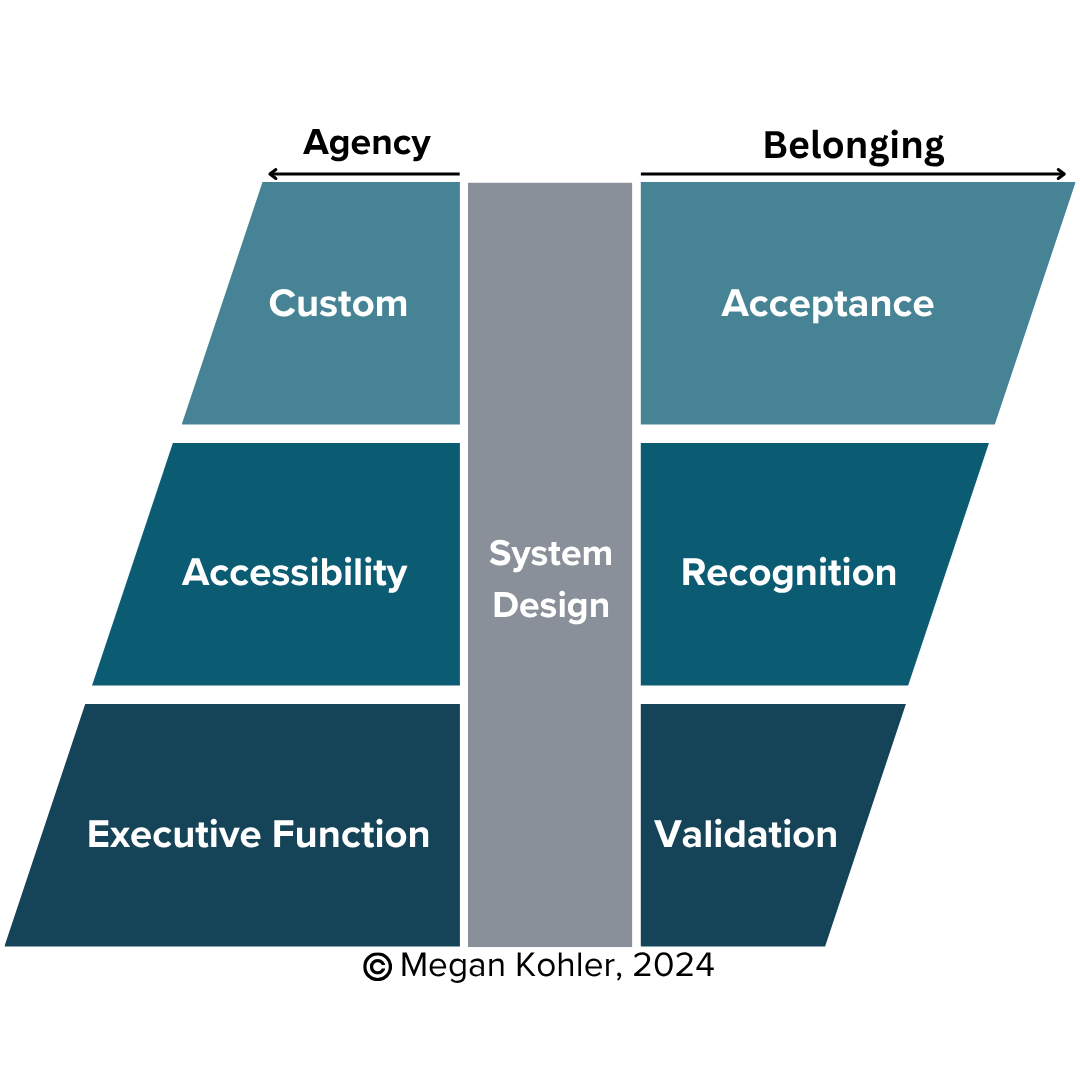
We often approach accessibility through standards, accommodations, and compliance. Those things matter, but neurodivergent learners invite us to consider a broader question: What if the difficulty is not located entirely within the learner? What if some of it is produced by how we design courses, communicate expectations, measure participation, and define success?

A course may technically be accessible while still demanding an exhausting amount of interpretation. Learners might encounter unclear instructions, inconsistent layouts, unnecessary time pressure, sensory overload, rigid participation requirements, or assignments that measure executive functioning as much as subject knowledge.

This challenges us to move beyond asking whether students can access our courses. We also need to ask what our courses require students to overcome before meaningful learning can begin.

At the same time, there is no single neurodivergent learner. A design decision that supports one person may create friction for another. More structure can provide security, but too much can feel restrictive. More choice can create agency, but it can also create decision fatigue. Recorded lectures may offer flexibility while introducing new difficulties with attention and processing.

There may not be one perfectly inclusive design. The goal may be to create thoughtful pathways that give learners greater clarity, flexibility, and control without leaving them to assemble the learning experience on their own.

Productive Challenge or Unnecessary Difficulty?

The conversation also made me think about Vygotsky’s concept of the zone of proximal development. This is the space between what a learner can accomplish independently and what becomes possible with appropriate guidance and support.

In education, we sometimes assume that difficulty is evidence of rigor. But not every difficulty contributes to learning. A student may be capable of engaging deeply with complex ideas while struggling with ambiguous directions, rigid time limits, sensory demands, or the executive functioning required to manage several overlapping tasks. These barriers can push a learner outside a productive learning zone without increasing the intellectual value of the experience.

This raises an important design question: Are we challenging students through the substance of what they are learning, or through the conditions we have constructed around that learning?

For neurodivergent learners, scaffolding might include predictable course structures, models of completed work, opportunities to practice before being evaluated, explicit explanations of expectations, flexible ways to participate, or tools that support planning and processing.

These supports do not remove rigor. They can make the intended rigor more reachable by directing the learner’s effort toward the knowledge or skill the course is meant to develop.

The zone of proximal development also reminds us that appropriate support cannot be entirely standardized. The distance between independence and supported possibility will differ from one learner to another. It may also change across tasks, environments, and moments in a student’s life.

Designing for that variability requires more than adding a fixed collection of accommodations. It requires learning environments that help students recognize what support they need and access it without stigma.

Designing With Learners

Another important consideration is the difference between designing for neurodivergent learners and designing with them.

It is easy for educators and instructional designers to make assumptions about what students need. Even well-intentioned assumptions can reduce people to diagnoses or generalized profiles. Listening, testing, and inviting learners into the design process can reveal barriers that experts may never notice.

However, this creates another responsibility. We should not expect neurodivergent students to repeatedly disclose personal information, represent an entire community, or educate the institution without recognition and support. Meaningful participation must be invited in ways that protect privacy and respect the value of students’ contributions.

Questions I Am Still Considering

The conversation left me with several questions:

  1. Are we challenging students through the substance of the learning, or through unnecessary barriers created by our course design?
  2. How can we distinguish productive struggle within a learner’s zone of proximal development from difficulty caused by an inflexible learning environment?
  3. Which course practices measure actual learning, and which primarily measure executive functioning, processing speed, social comfort, or tolerance for ambiguity?
  4. How can we design with neurodivergent learners without requiring them to disclose personal information or repeatedly educate the institution?
  5. Who gets to define what meaningful participation, engagement, and success look like?

That final question feels especially important. In education, we can unintentionally privilege the learner who responds quickly, speaks comfortably in groups, maintains eye contact, processes information in familiar ways, and demonstrates attention in visible forms. When those behaviors become proxies for engagement, we risk misunderstanding students whose learning is real but expressed differently.

Designing for neurodivergent learners is not about lowering expectations. It is about becoming more precise about which expectations genuinely serve learning. It asks us to preserve meaningful challenge while removing friction that contributes little to the intended outcome.

Perhaps rigor should not be measured by how much difficulty a student can endure independently. A better measure may be the depth of learning students can reach when challenge and support are intentionally designed to work together.

This work requires more than adding accommodations after barriers appear. It requires curiosity about the assumptions embedded in our courses and humility about how much we still need to learn.

Perhaps the most useful starting point is not, “How do we help neurodivergent students succeed in the courses we have designed?”

It may be, “What can neurodivergent learners teach us about designing better learning environments for everyone?”

The Loudest Boat on the Quietest Lake

We are twelve people on a pontoon made for maybe half that.There are tangled lines everywhere, someone is already crying, and the only quiet thing on Huzzy Lake this Father’s Day is the water itself.

For the past few years, this has been our tradition.
My dad, my brothers, and all our sons meet up at my brother’s place on Huzzy Lake in Lawton, Michigan.
We pile onto his pontoon boat and launch ourselves into a few hours of “fishing” together.

It is loud.
It is messy.
And I hate it.

I don’t hate the people, of course.
I love my dad.
I love my brothers.
I love watching my boys light up when Grandpa gets excited.
But if I were designing my perfect Father’s Day, it would not look like twelve humans and a cooler on aluminum flooring, hooks flying past ears while someone drops a bag of chips into the live well.

If I’m honest, it would look almost like the opposite.

In my head, fishing is supposed to be quiet.
A dock at sunrise.
A small boat with one or two people who understand that silence is a kind of reverence.
You cast.
You wait.
You listen to the birds and the faint whine of the line in the wind.
You think your own thoughts and, every once in a while, you share a few with the person next to you.

That is fishing, as I believe it should be.

And every year, instead, I find myself on the loudest boat on the quietest lake.

So why do I keep saying yes?

Because my dad loves it.
Because my boys love it.
Because, against my preferences, I’m starting to suspect this noisy ritual might be doing something important in me.


This year, my brother showed up wearing a white t‑shirt with black letters across the sleeve: LIVE LOUD.

The shirt looked like something from a Christian clothing line or a conference merch table—the kind of thing meant to encourage you to be bold in your faith, to stand out, to make noise for Jesus.

As I watched my sons cast into the same patch of water for the tenth time, the shirt felt like a caption for our boat.
We were, without question, living loud.

Kids were shouting.
Uncles were telling stories at full volume.
My dad was calling out instructions.
Something was always being spilled or dropped or accidentally hooked.

And yet, at the same time, I couldn’t shake how strange that phrase sounded to me as a Christian.

Live loud.

I’ve sat in church my whole life, and I couldn’t think of a single place in Scripture where we’re called to live loudly.
I could, however, think of several that call us to something very different.

The apostle Paul tells a young church to make it their ambition to lead a quiet life, to mind their own business and work with their hands so that their everyday life would win the respect of outsiders.
He urges believers to pray for those in authority “that we may lead a peaceful and quiet life in all godliness and dignity.”
Peter writes about the “hidden person of the heart,” the beauty of a gentle and quiet spirit that is precious in God’s sight.

Quiet life.
Peaceful and quiet life.
Gentle and quiet spirit.

The more I sat with those words, the stranger “live loud” sounded as a banner for Christian faith.


Of course, those passages aren’t telling us never to speak, never to protest, never to sing loudly or laugh hard or shout for joy.
But they do point toward a particular kind of posture—a way of being in the world that is unhurried, non‑anxious, and deeply rooted.

To “lead a quiet life” is to live free from meddling and constant disruption, to stay busy with the work God has given you instead of being busybodies in everyone else’s business.
It is about a settled, ordinary faithfulness that, over time, wins the respect of those outside the church not because it is flashy, but because it is stable and good.

That vision feels especially important in American Christianity, where faithfulness is often confused with visibility.
We live in a culture that rewards volume—followers, platforms, strong takes, going viral.
It’s not surprising that Christian subculture has often baptized that logic: boldness becomes a brand, and “live loud” turns into a slogan we can sell.

I’m not immune to any of that.
I write.
I teach.
I like ideas and conversations and, yes, sometimes microphones.

But God keeps bringing me back to this quieter call: aspire to live quietly, to be faithful in the small place right in front of you.

And on Father’s Day, that place looked like a pontoon full of people I love, making way more noise than I would ever choose.


Here’s what I’m coming to see:
Sometimes the most faithful thing we can do is live quietly on the inside while the world—and the pontoon—are loud on the outside.

I do not control the volume of my extended family.
I cannot make my dad prefer contemplative fly fishing at dawn.
I cannot convince my sons that the “right” way to fish is to whisper and watch the water for hours.

What I can do is choose how I show up.

I can choose to drive to Lawton even when every introverted cell in my body wants a solo morning with a book and a quiet shoreline.
I can choose to untangle lines without sighing.
I can choose to listen to my dad’s stories and my boys’ excited nonsense without constantly calculating how much more peaceful the day could have been if we’d done it my way.

I can choose, in other words, to let my preferences die a little bit for the sake of love.

It is not glamorous.
It does not make for an inspiring t‑shirt.
It is, however, a very quiet kind of obedience.

Philippians talks about considering others more significant than ourselves, looking not only to our own interests but also to the interests of others.
On the boat, that doesn’t look like a profound spiritual moment.
It looks like moving so my nephew has space to fish off the side, or sitting in the hot sun longer than I’d like because my dad is still talking to one of my boys about the best bait for bluegill.

None of that changes the fact that I still don’t enjoy the chaos.
I don’t think I ever will.

But I’m starting to see that sometimes a “quiet life” doesn’t mean a quiet environment.
Sometimes it means a quiet heart in a loud environment—a heart that is not resentful, not sulking, not silently keeping score, but present and willing to love in the noise.


As I’ve thought about this, I’ve started to wonder: where is the loud boat in your life?

Maybe it’s an aging parent who repeats the same stories.
Maybe it’s a church service that is nothing like your ideal.
Maybe it’s a workplace, a neighborhood, a classroom, a family gathering where the volume (literal or metaphorical) is always higher than you’d prefer.

There is a place you keep showing up to, mostly out of love or commitment, where part of you would rather be anywhere else.

What would it look like to receive that place as one of the ways God is teaching you a quiet life?
Not a life of withdrawal or resentment, but a life where your soul learns how to be at rest in Him even when the circumstances are restless.


Later in the morning, after a few hours of noise and sun and snacks, my youngest hooked a bluegill.

The boat erupted.
Everyone shouted.
The pontoon rocked as twelve people leaned toward the same small moment.
My dad grinned like he used to when we were small and he was the one unhooking fish for us.

The lake, somehow, stayed quiet.
The distant shorelines did not care that we had disturbed the air again.

Standing back on shore, watching my boy beam and my dad’s eyes crinkle at the edges, I felt something shift—not in the volume around me, but in the volume inside me.

Somewhere under the surface, in a place too deep for slogans, I sensed a small, stubborn yes.
Not a yes to “living loud,” but a yes to loving well in the noise.
A yes to the quiet work of showing up again next year, and the year after that, and the year after that, to the loudest boat on the quietest lake.

And maybe that is one of the ways God is teaching me what a quiet life really means.

Finding a Ghost Track in My Own Backyard

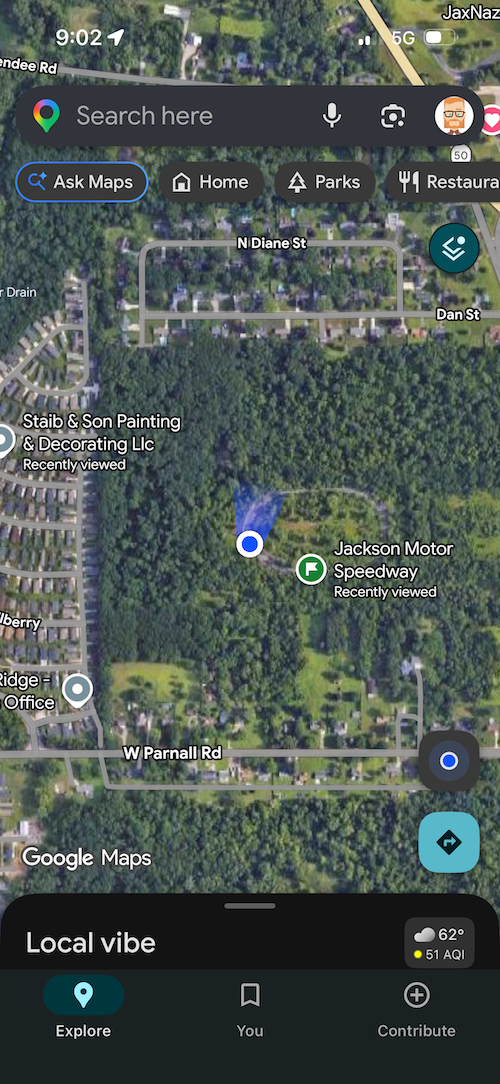
Last night, I fell down one of those delightful internet rabbit holes. It started with a short TikTok from History Mystery Man, the historical storyteller who specializes in lost racetracks and forgotten places. In the video, he mentioned an abandoned speedway “hidden in the woods north of Jackson, Michigan.” As soon as I heard “north of Jackson,” my educator brain and my local‑history curiosity both lit up. Where exactly was this place?

I pulled up Perplexity and started digging. Within a few minutes, I had an approximate address and satellite imagery for the old Jackson Motor Speedway: a ghost track sitting just west of US‑127, about two miles north of downtown, tucked back in the trees near Clinton Way. When I realized that this legendary racetrack had been sitting literally a couple miles from my house in Jackson, I just sat back in my chair, stunned. Somehow, a piece of Michigan’s racing heritage—and my own family story—had been hiding in plain sight.


Racing in the Family

To be clear: I’m not a “car guy” in the way my grandfather, my dad, and my uncle were. I can appreciate a beautiful machine, but I don’t live for horsepower specs or race schedules. Still, racing runs deep in my family’s bloodstream.

My grandfather and my dad grew up in the era when Jackson Motor Speedway was in its prime—late 1940s through the 1960s—when the half‑mile high‑banked dirt oval and later its shorter, unusual paved configuration drew huge crowds on summer nights. Back then, this wasn’t just local entertainment; it was part of a broader outgrowth of Michigan’s automotive story. The industrial genius that put the world on wheels also gave rise to a culture of speed, risk, and competition, and small tracks like Jackson became breeding grounds for drivers who would go on to run at places like the Indy 500.

So when I realized that this “legendary racetrack hidden in the woods” was not just somewhere in mid‑Michigan but essentially in my neighborhood, it felt strangely personal—like discovering a forgotten chapter of my family’s biography carved into the landscape.


From Screen to Soil

The more I watched, the more I wanted to go see it for myself. History Mystery Man’s YouTube video on Jackson Motor Speedway gives a haunting, detail‑rich walk‑through: the opening in 1948 under the Stull family, the later paving that changed the character of the track, the slow decline amid competition from Michigan International Speedway, and the sobering tally of seven lives lost on those high banks.

This morning, curiosity got the better of me. I drove up 127, turned off near the old address, and circled around until I found a spot that looked like a reasonable point of entry—no “No Trespassing” signs, just a quiet stretch of woods. I parked, stepped into the trees, and followed a faint path. Within minutes, the forest opened up, and there it was.

The oval was still there: cracked pavement, weeds and saplings pushing through, berms softened by decades of weather. I walked up onto the banking and started around the track. It’s surreal to stand on asphalt that once carried roaring fields of stock cars and open‑wheel machines, now silenced except for birds and wind. Knowing that thousands of people once filled the stands and that some never came home from this place made the quiet feel thick, almost reverent.


Appreciating What I Don’t “Do”

Even though I’m not personally immersed in motorsports, walking that track crystallized something for me about appreciating what others love. I don’t have memories of Saturday nights at Jackson Motor Speedway, but my father and grandfather did. For them—and for countless families across mid‑Michigan—this was more than a hobby. It was community, ritual, and identity.

As someone who spends his days thinking about learning, narrative, and human flourishing, I find it moving that a seemingly niche interest like local auto racing can be a deep well of meaning: shared risk, craftsmanship, camaraderie, and the simple joy of speed. Finding this ghost track reminded me that honoring the passions of the people we love is one way we honor them—and that the landscapes around us are often holding our stories long after we’ve forgotten where they were written.


A Hidden Classroom

From an educator’s perspective, Jackson Motor Speedway is a ready‑made “hidden classroom.” It’s a site where you can talk about:

  • The history of the automobile industry and its cultural outgrowths.
  • Risk, safety, and community memory, including the very real lives lost here.
  • How places transition from hubs of activity to abandoned sites, and how narratives like History Mystery Man’s help keep them from disappearing entirely.

Last night, a TikTok nudge and an AI search turned into a short pilgrimage: from a glowing screen, to a map, to a quiet walk on an overgrown oval hidden in the woods. It left me grateful—not just for the tools that helped me find it, but for the invisible threads that tie global histories, local landscapes, and family stories together in ways we often only notice by accident.

The Moment Before You Don’t

I noticed how small the chapter is.

And how exposed it feels.

Chapter 2 sits right at the hinge.

Before technique.

Before confidence.

Before success stories.

It asks a quieter question.

Why do you hesitate when you know what to do?

That question stays with me.

The chapter names hesitation as a habit.

Not a flaw.

Not a lack of character.

That matters.

In psychology, habits form where effort feels costly.

Your brain learns to delay to protect energy.

It rewards comfort.

It avoids uncertainty.

This chapter does not argue with that system.

It sidesteps it.

The central claim is simple.

If you wait to feel ready, you will not move.

Readiness follows action, not the other way around.

I see this pattern everywhere in education.

  • Students wait to feel confident before starting.
  • Faculty wait to feel prepared before redesigning.
  • Leaders wait to feel certain before naming tension.

The wait becomes the blocker.

What struck me most is how the rule reframes responsibility.

You are not asked to fix your mindset.

You are asked to interrupt a moment.

That is a design move.

Not a moral one.

Design beats intention.

Every time.

The chapter also names something uncomfortable.

Your mind is not always on your side.

It tells stories that feel protective.

They sound reasonable.

They arrive fast.

If you give them time, they win.

The countdown is not magic.

It is a boundary.

It says:

This thought does not get the floor right now.

Pause here.

Where in your day do you sense the delay creeping in?

Not the big life choices.

The small ones.

  • Sending the message.
  • Opening the document.
  • Standing up when you want to sit.

This chapter does not change your life.

It changes the first five seconds.

That is its honesty.

And maybe its risk.

If change is small and repeatable,

you cannot blame complexity anymore.

You either move.

Or you notice yourself not moving.

That awareness alone feels like the work.

5 Seconds Before I Talk Myself Out of It

I opened chapter one early in the morning.
Coffee cooling.
House still quiet.

The promise was simple.
Count backward.
Move.

I noticed my first reaction.
Skepticism.
Not intellectual.
Protective.

I have spent years studying motivation.
Teaching it.
Designing for it.
Researching it.

And still, I hesitate.

Chapter one names something I recognize right away.
• You feel the impulse.
• You start to think about it.
• The thinking drains the energy.
• You stay where you are.

That part landed.

Not because it was new.
Because it was exposed.

The rule itself feels almost too small.
• Five seconds.
• No insight.
• No meaning-making.
• Just action.

My resistance showed up fast.
• This ignores complexity.
• This bypasses reflection.
• This feels behaviorist.

All fair critiques.

And yet.

I noticed how often I wait for clarity before I move.
I tell myself it is wisdom.
Sometimes it is.
Sometimes it is fear with better language.

Chapter one makes a narrow claim.
You do not need motivation to begin.
You need movement.

That is uncomfortable.

It challenges a belief I hold quietly.
That understanding should come first.

What if action is not the reward for insight?
What if insight follows action?

I thought about my own patterns.
• Writing I delay until I feel ready.
• Conversations I rehearse instead of starting.
• Health choices I plan but postpone.

None of those are solved by more thinking.

The chapter does not argue.
It interrupts.

It says: when you feel the pull, move before your mind negotiates you out of it.

I am not convinced.
But I am curious.

That feels like enough for now.

Here is the question I am sitting with.

Where in your life are you waiting for permission that only action can give?

I am closing the book there.
Not to agree.
To notice.

Tomorrow, I will try the count.
Not as a solution.
As an experiment.

Reading The 5 Second Rule in Public

I keep noticing a pattern.

I read books alone.

I underline.

I nod.

I change very little.

This year, I want to try something different.

I am starting a public reading series called Reading The 5 Second Rule in Public.

The book is The 5 Second Rule by Mel Robbins.

I have owned it for years.

I have started it more than once.

I have never finished it.

That matters.

I work in higher education.

I study motivation, learning, and behavior change.

I teach people how learning moves from insight to action.

And yet.

I still avoid small, obvious steps when they feel exposed.

I still wait for clarity instead of choosing movement.

I still confuse thinking with doing.

This series is an experiment.

Not in productivity.

Not in self-improvement theater.

In accountability.

Here is the plan.

  • I will read slowly.
  • I will write honestly.
  • I will name resistance when it shows up.
  • I will not pretend the ideas are new if they are not.
  • I will not rush to apply or defend them.

Each post will do one thing.

It will ask:

What happens when you stop reading for insight and start reading for movement?

I am not sure what will happen.

I do know this.

Private resolve is cheap.

Public practice costs something.

That cost is the point.

If you read along, you are welcome.

If you try the rule yourself, even once, notice what you feel in your body when the countdown starts.

What do you protect by waiting?

What do you risk by moving?

I am starting with the first page.

I am starting without a guarantee.

I am starting now.

How My Brain Learned to Let Go

Nine sessions.

Each one quiet on the outside.

Each one seismic on the inside.

A few people have ask what changed.

I struggle to answer because the experience did not feel like learning something new.

It felt like my brain finally stopped gripping the same old grooves it had been trapped in for decades.

I did not feel “high.”

I did not see dramatic visions.

I felt space.

Mental space.

Emotional space.

Just enough room for something deeper to shift.

For months, I could not explain why it helped.

Then I watched a video by Chase Hughes titled “Neuroscience JUST Did the IMPOSSIBLE.”

You can watch it here:

As he walked through recent neuroscience research, something clicked.

Not metaphorically.

Mechanistically.

Here is the simplest way I can explain it.

Your brain is not just a collection of thoughts.

It is a living network of connections.

Those connections decide:

  • What you notice
  • What you ignore
  • What feels dangerous
  • What feels possible

When you live with depression, trauma, or chronic anxiety, the problem is not weak willpower.

The problem is that certain brain networks keep talking to each other in the same tight loops, long after those loops stopped being useful.

Think of it like this.

  • The same roads get driven every day
  • Other roads slowly disappear
  • Flexibility is lost

That is what I felt stuck inside before ketamine.

In the video, Chase explains research showing that mental experiences leave reliable signatures in brain activity. Using advanced brain imaging and AI, scientists can reconstruct rough images of what a person is seeing based only on neural data.

Not in a sci-fi way.

In a pattern-recognition way.

That matters because it tells us something important.

Inner experience is not vague or mystical.

It is physical.

It lives in circuits.

And circuits can change.

The second piece of research he discusses mattered even more to me.

It comes from a recent paper published in Cell that examined what happens in the brain after a single dose of psilocybin in mice:

Here is the core idea.

Psilocybin did not just activate the whole brain.

It opened a window.

During that window, the networks that were active got rewired.

Some connections strengthened.

Others weakened.

And the pattern depended on which brain regions were active during the experience itself.

That line stopped me cold.

Because during my ketamine sessions, my brain was not rehearsing shame, fear, or self-attack.

Those loops went quiet.

Instead, other things came online:

  • Sensory awareness
  • Bodily calm
  • Memory without panic
  • Reflection without punishment

The research shows that when those kinds of networks are active during a plasticity window, they are the ones that get reinforced later.

Not forever.

But enough to matter.

Enough to change default settings.

That matches my experience almost exactly.

After the sessions:

  • My thoughts slowed
  • Emotional reactions softened
  • Old triggers lost some grip
  • I had more room to choose my response

Nothing magical happened.

Something biological happened.

The brain regions that usually kept each other trapped in feedback loops loosened their hold.

Other pathways strengthened.

I did not become a different person (or did I?).

I did become less imprisoned by one narrow version of myself.

That is why the therapy mattered.

Ketamine was not the healing.

The context was.

  • Safety
  • Guidance
  • Intention
  • Stillness

The medicine made my brain more willing to update itself.

That is both the promise and the responsibility of this research.

If the brain becomes especially malleable under certain conditions, then the conditions matter deeply.

Healing does not come from chemicals alone.

It comes from what the brain is doing while it is open to change.

That leaves me with a question I still sit with.

If your brain were given a rare window to rewire itself,

what patterns would you want active in that moment?

Fear?

Control?

Or presence, compassion, and truth?

That question is not just about ketamine or psychedelics.

It is about how you live every day.

Why an AI Pendant Can’t Fix Our Loneliness

I spent part of the early morning watching a documentary about the Friend.com pendant, a tiny AI “companion” device that clips to your shirt and promises something bold. Not productivity. Not information. Friendship.

The documentary left me thinking less about the product itself and more about what it reveals about us.

You can decide for yourself whether you’d ever wear something like this. My hope is that you walk away asking deeper questions than “Does it work?”

What the device tries to be

• The pendant uses Claude to send text messages that mimic emotional presence.

• There’s no screen, no speaker, no real interface.

• It connects over Bluetooth and feeds you short replies.

• It claims to offer companionship without pretending to be a tool.

You’re asked to wear it over your heart. That symbolism isn’t subtle.

What people actually experienced

• Most reviewers reported delays, fragmented replies, and strained attempts at emotional intimacy.

• Several described it as “needy.” One person said it felt like wearing a “senile anxious grandmother.”

• It often misread social cues and struggled to respond in real time.

When your friend lives in the cloud, awkwardness becomes a feature, not a bug.

The human behind the hype

• The founder is young, ambitious, and willing to provoke.

• His startup pivots created confusion and doubt.

• His marketing campaign burned through more than a million dollars in New York subway ads.

• Graffiti and public backlash followed, but he welcomed the controversy.

It raises a question: when does a product stop serving people and start serving a narrative?

The privacy tension

• The device listens to your environment.

• Liability shifts to the user.

• The company promises quick data deletion, but trust is already damaged.

If a device meant to offer companionship introduces fear instead of safety, what relationship is it really inviting?

The deeper cultural story

You can’t watch this documentary without reflecting on the larger patterns at work.

• Loneliness is rising, especially among younger generations.

• Many of today’s teens spent formative years isolated during lockdown.

• AI companionship is becoming a serious market, not a fringe idea.

• Some people report psychological strain from forming emotional dependence on AI systems.

The device becomes a symptom. The real story is the ache underneath.

Ask yourself: why are products like this resonating at all?

A growing trend

• Robot pets.

• Sentient-styled chat companions.

• Wearable AI friends.

These aren’t tech novelties anymore. They’re responses to unmet social needs.

We keep trying to automate connection. But connection has never been an efficiency problem.

The ethical crossroads

Every generation invents tools. But some tools reshape the people who use them.

This pendant feels like a reminder that technology often sprints ahead of the human questions it raises.

What do we lose when companionship becomes a product?

What happens to emotional development when we outsource intimacy?

Who gets harmed when we design devices without understanding the psychology they tap into?

I keep thinking about real students, real families, real communities. We thrive through mutual recognition. Through presence. Through shared life.

A pendant can’t do that for you.

What you might ask yourself

• What kind of connection are you actually longing for?

• Who in your life already offers pieces of that connection?

• What practices strengthen your capacity for real relationship?

• How does technology support your formation rather than distort it?

You know your own story better than any device can.

Would I wear it?

No.

But not because it’s clunky or awkward or poorly designed.

I wouldn’t wear it because I want my friendships to shape me.

Not a product.

Your turn

Would you ever wear an AI companion, or does it feel like a distraction from the relationships that matter most in your life?

after the collision

I got an accident this week and this is a poem, reflecting on it with gratitude.

yesterday,

steel met steel,

and i lived.

the sound was thunder —

then stillness.

my breath returned

like a shy child

unsure if it’s safe to come out again.

they call it survival.

i call it grace.

this summer,

ketamine cracked open

a door i thought was sealed forever.

colors bled back into the world.

the dark finally had edges.

i saw my wife’s eyes

like sunrise through fog.

i heard my boys laughing

and didn’t flinch.

i tasted coffee,

not just swallowed it.

depression once whispered,

“nothing matters.”

now i whisper back,

“everything does.”

every raindrop.

every hand i hold.

every “i love you”

said and unsaid.

gratitude is not a mood.

it’s a pulse.

it’s breath against the odds.

it’s saying yes

to this fragile, blazing, borrowed life —

again and again and again.

and i lived.