Reflecting on Why Young Men are Falling Further Behind:

For decades, the stereotype of the out-of-shape man in his 30s living in his parents’ basement was played for laughs. Today, it’s no longer just a joke—it’s a social reality. More than half of men ages 18–30 live at home in the U.S. and Australia. What was once comic relief has become commonplace.

The recent ColdFusion documentary “Why Young Men Are Falling Even Further Behind” explores why this is happening and what it means for society. Watching it left me with a mix of concern and urgency. Here are some of the key insights—and questions—we should be asking.

Education Gaps Start Early

  • Two-thirds of high school top performers are girls, while two-thirds at the bottom are boys.
  • Women are now significantly more likely to earn a college degree in almost every developed nation.
  • Reading readiness is central. Only 29% of boys aged 0–2 are read to daily compared to 44% of girls. That gap sets a trajectory that ripples through academic and social development.

Question: Are we willing to confront how family practices and early education quietly disadvantage boys from the start?

Work and Economic Shifts

  • Traditional male-dominated industries—manufacturing, construction—have declined.
  • Service industries, where communication and relational skills matter most, have surged.
  • Women have entered male-dominated fields, which is good for equity, but it also increases competition for young men who lack preparation for service-oriented careers.

Reflection: The old pathways of “a stable job, a family, and a house” no longer map neatly for young men. What new pathways can we create?

The Loneliness Epidemic

  • In 1990, 55% of men reported six or more close friends. By 2021, that number dropped to 26%.
  • The percentage of men with zero friends rose 500% in the same period.
  • This loss of social capital feeds cycles of isolation, aimlessness, and disengagement from school and work.

Question: What role should schools, communities, and even workplaces play in rebuilding friendship and belonging for men?

Dating and Relationships

  • Nearly 30% of men reach age 40 unmarried today, compared to single digits in the 1970s.
  • Many men report fear of approaching women in the wake of the #MeToo movement. Half of men ages 18–25 say they’ve never approached a woman at all.
  • Meanwhile, dating apps create uneven dynamics: women receive thousands of matches while many men get none.

Challenge: How can young men (and women) learn healthy relational confidence in a culture shaped by fear, digital platforms, and shifting gender expectations?

A Sense of Purpose

Richard Reeves and Scott Galloway argue that young men increasingly feel unnecessary—to their families, their communities, or society. That loss of purpose feeds despair, sometimes with dangerous outcomes. Suicide, overdose, and incarceration rates are dramatically higher among men.

When purpose disappears, unhealthy substitutes emerge. Influencers peddling shallow “masculinity” find a ready audience among young men searching for direction.

What Can Be Done?

The documentary points to promising interventions:

  • Early literacy for boys (prioritize reading between ages 1–4).
  • Mentoring and social-emotional programs (like Chicago’s Becoming a Man).
  • High-quality apprenticeships to create real pathways into work.
  • Male-friendly mental health initiatives to reduce isolation.
  • Recruiting more male teachers, especially in reading and English.

These steps don’t diminish efforts to support women. They acknowledge that equality requires attention in both directions.

Moving Forward

This is not about re-establishing old hierarchies. It’s about recognizing where young men are faltering and asking how we can create systems that help them flourish.

  • What if we delayed school entry for boys to account for slower brain development?
  • What if we reimagined literacy practices at home, encouraging fathers to read to sons?
  • What if we built cultural permission for men to need friendship and seek help?

Final Thought

The crisis facing young men isn’t a niche issue. It’s a social one. A society where men are aimless, isolated, and undereducated is one where everyone loses. The good news is that solutions exist—if we’re willing to look honestly at the problem and commit to change.
When Study Mode Arrived… on My Birthday

On July 29, 2025—yes, happy belated birthday to me—OpenAI surprised us all by launching Study Mode in ChatGPT. It wasn’t just any release; it felt like a landmark moment: the AI stepping off the answer-delivery stage and sliding into a Socratic, tutor‑in‑your‑pocket role. The tool intentionally introduces friction—nudging learners to think, reflect, and engage rather than just skim the back of the math book for answers.

What the Heck Is Study Mode, Anyway?

Fast-forward through the rollout to real use:

  • It asks questions to understand your level and goals, scaffolding responses bit by bit.
  • It throws in quizzes or open‑ended prompts to check understanding.
  • And yes, it still lets you bail out and get the swift answer—but it gently reminds you you’re here to learn.

Reviewers give it a cautious nod of approval—especially for STEM. One author praised how it resisted giving answers and kept them thinking, even through quantum mechanics.

The Old You vs. Study Mode: Temptation in the Back of the Book

You remember that when you were younger, you’d sneak a peek at the answers in the back of the book—not because you didn’t want to learn, but because you hit a wall. Temptation won. Study Mode flips that script; when you ask for the answer, it pushes back:

“I’m here to help you learn, not just give you the answer.”

In essence, it’s built to teach how to think, not what to think. But here’s the sticky part: that toggle is a click away. Always.

WIRED warns of just that risk: younger students, still building their self‑control, may simply click out of Study Mode to get that quick solution.

Can This Be Designed For—or Must It Be Instilled?

Merrill’s First Principles remind us: meaningful learning happens when learners are engaged in solving real tasks, when they receive guidance, and when they reflect on their thinking. Study Mode introduces those exact principles—scaffolded tasks, Socratic guidance, reflection checkpoints.

But here’s the heart of it: Technology can nudge, but it can’t reinforce resolve. You need both:

  • Designed-in friction: Study Mode gives students structure and prompting.
  • Learner mindset: It’s up to you (or your students) to stay curious, resist the shortcut, and do the real work—because the reward isn’t a grade—it’s the habit of thinking deeply, which stays with you forever.

As Leah Belsky, OpenAI’s VP of Education, framed it: when the tool is used as a tutor and not just an answer engine, it can significantly improve academic performance.

A Little Birthday Lesson, Gift Wrapped

So, as Study Mode debuted on my birthday, here’s my gift to you (and your blog readers): a reminder that true learning isn’t about speed—it’s about depth. ChatGPT’s new mode can be designed to foster thinking, and we can equip learners to choose that path. But the real magic—where understanding sticks—is when the learner refuses the shortcut, stays curious, and decides to think for themselves. And no AI can take that away from you.

What Are We Really Automating?

A Response to Punya Mishra on AI and Creativity

My friend and colleague Dr. Punya Mishra recently gave a talk on generative AI and creativity that was full of insight, humor, and challenge. You can always count on Punya to make you laugh and think at the same time—and this talk was no exception.

He described generative AI as a “smart, drunk, biased, and supremely confident intern,” which might be the most accurate (and entertaining) description I’ve heard yet. He also shared inspiring examples of using AI to create poems, music, interactive simulations, and visual art—most of which he had no technical background to build from scratch.

His point was clear: when accuracy doesn’t matter, and when we come to AI as curious, creative teachers and designers, something genuinely exciting can happen.

But as I listened, I also found myself wondering about some deeper and maybe less comfortable questions—questions that I think we, as educators and designers, need to be asking ourselves more often.

1. Are We Outsourcing Emotional Labor?

Punya noted a recent trend: users increasingly turning to AI not for ideas, but for therapy and companionship. In fact, “companionship” has now surpassed “idea generation” as the top reason people use chatbots like ChatGPT.

That gives me pause.

Are we outsourcing our need to be heard and known to something that can only mimic understanding? What does that do to our capacity for genuine human connection, especially for young people already navigating digital saturation and identity formation?

Is AI becoming not just a tool but a substitute relationship?

2. What Kind of Creativity Are We Valuing?

Punya showed how AI can help us make things—quickly, beautifully, and in many styles. But I wonder if that ease could quietly reshape our definition of creativity itself.

Are we drifting toward creative outputs that machines are good at—things with recognizable form, familiar rhythm, predictable elegance?

What about the messy, uncertain, deeply human kinds of creativity that resist polish and take time? Do we risk optimizing for style over substance?

3. What Happens When AI Becomes Our Co-Teacher?

Many educators are now using AI for lesson planning, quiz generation, grading, and feedback. On the surface, that sounds efficient. But efficiency can be a trap.

If AI takes over the design work, what happens to our joy in teaching? Our intellectual ownership? Our sense of craft?

Do we begin to devalue deep reflection and slow pedagogical thinking simply because the “intern” is always ready with a faster answer?

4. Who Gets Left Out of This Future?

It’s easy to celebrate these tools when you’re a well-resourced, tech-savvy, curious educator. But not everyone has the time, bandwidth, or institutional support to explore AI in this way.

Whose voices are reinforced by AI, and whose are distorted or erased? What cultural assumptions are baked into the systems we’re now treating as co-authors and collaborators?

If we don’t wrestle with those questions, are we just building another layer of inequality into education?

5. What Should Never Be Automated?

Here’s the questions I keep returning to:

What if the real danger isn’t the tool—but the logic behind it?

The idea that everything complex should be made frictionless?

As someone who works in the world of learning experience design, I spend much of my time helping people navigate ambiguity, uncertainty, and growth. These are not processes we should automate. These are deeply human experiences we need to protect.

Punya’s talk reminded me of what’s possible. This response is a way of holding space for what’s at stake.

Let’s keep building with these tools. But let’s also keep asking the harder questions.

Not because we’re afraid of AI.

But because we care about what it means to be fully human.

High Five 4000: My Favorite Middle Finger at the Gallery

This afternoon, I walked into The Gallery at Washtenaw Community College expecting to see paintings, maybe a few sculptures, something that might make me think or slow down.

I didn’t expect to be applauded by a rubber hand on a stick.

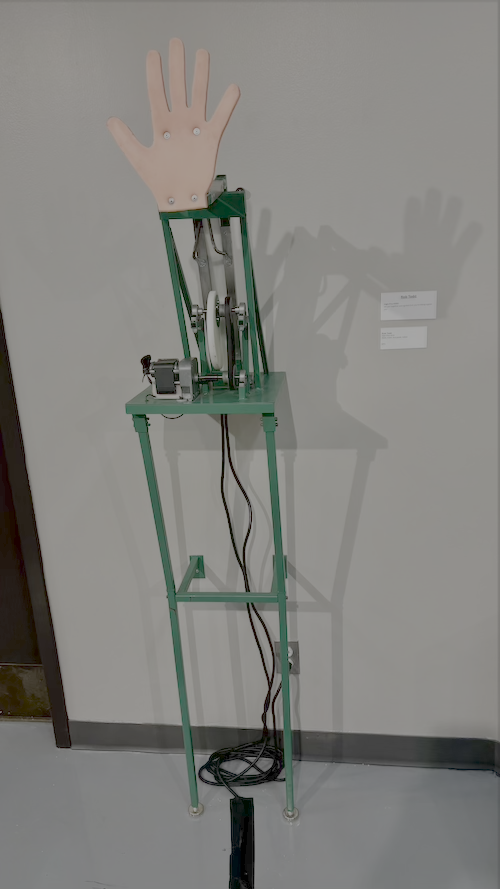
And yet, there it was: Rob Todd’s High-Five 4000. A simple green metal frame, a foot pedal, a motor, a gear, and a soft rubber hand poised and ready for action. Tap the pedal, and whap—you’ve been affirmed.

Sort of.

The placard next to the piece reads:

“We got together and agreed that you’re doing a great job!”

It’s brilliant. It’s savage. It’s hilarious. And it says more about modern work culture than a hundred TED Talks.

This is not a machine that celebrates you. This is a machine that mimics celebration. It parodies the way we’ve automated everything—even encouragement.

The High-Five 4000 doesn’t care how you’re doing. It was built not to care. That’s the point. It’s the kind of machine you might find in the break room of a tech startup where no one knows your name but your Slack bot says “Nice work!” when you check off a Jira ticket.

Honestly, it feels like a rage-against-the-machine punk anthem in visual form. Quiet and motionless until you press the pedal—then it springs to life with the emotional depth of a golf clap.

And I love it.

Because under the surface humor is a sharp critique: we’ve industrialized affirmation. Outsourced the high five. And called it morale.

This thing could sit on the 18th hole with the white-collar bros toasting quarterly gains they had nothing to do with. It could be installed in HR departments across America where we confuse policies with care.

But maybe—just maybe—it also reminds us that a real high five still matters. That humans were never meant to automate encouragement. That someone looking you in the eye and saying, “You’re doing a great job,” still means something.

And maybe it takes a fake rubber hand to help us remember that.

A Garden Grows in Memory: A Tribute to George Shaver of Ella Sharp Park

By Dave Goodrich

A Quiet Legacy in Bloom

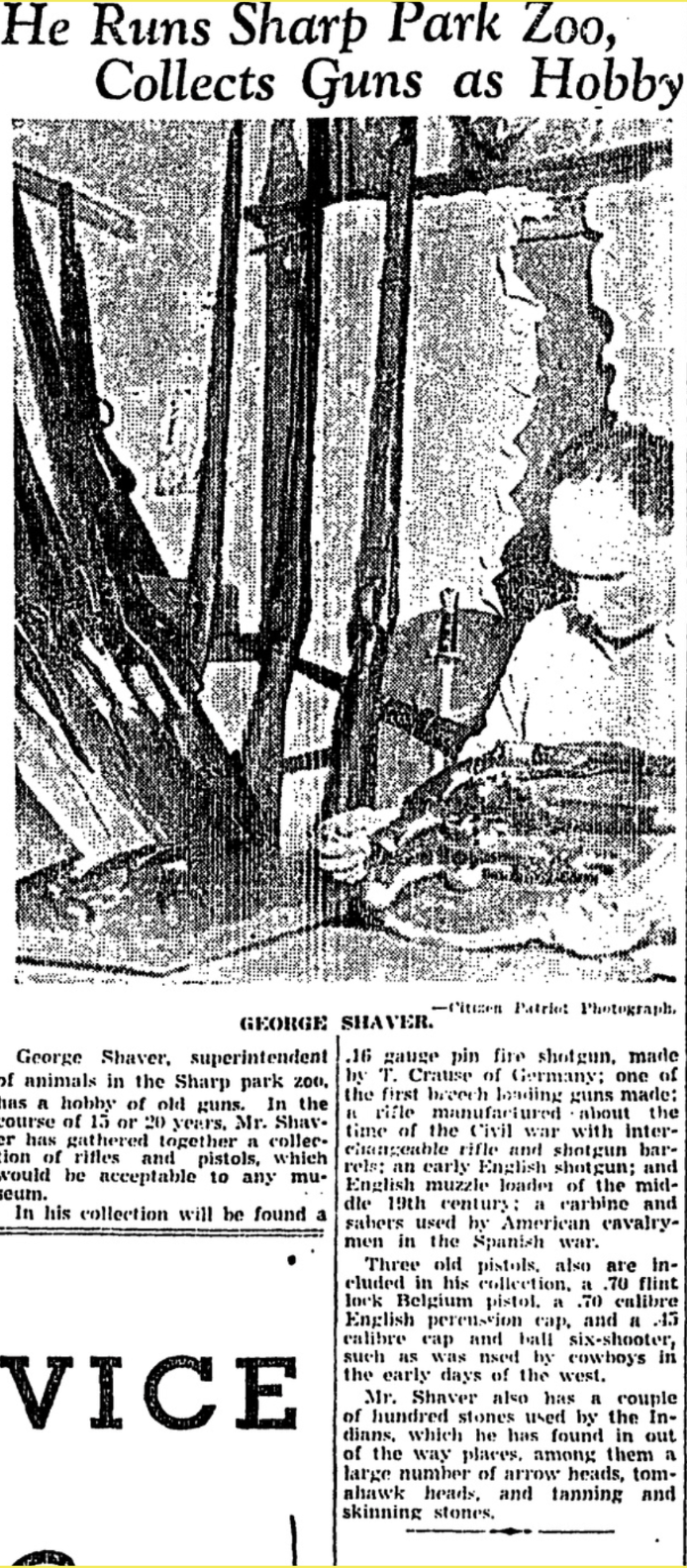
Before I was born, before my mother was even grown, a man walked the paths of Ella Sharp Park with soil on his hands and quiet pride in his heart. His name was George Shaver, and he was my great-grandfather.

George served as the head gardener at Ella Sharp Park in Jackson, Michigan from the 1940s through the 1960s. But “gardener” doesn’t begin to capture the legacy he left. He was a caretaker in the truest sense—of plants, animals, and people’s memories. He tended beauty for a city. He made a park come alive.

Roses, Animals, and the Soul of a Park

In those midcentury decades, families came to Ella Sharp not just for picnics and playgrounds, but for wonder. There was the formal rose garden—rows and rows of color, scent, and bloom, first planted as a memorial to Ella Sharp in the 1920s. By the time George came to tend it, it had become the city’s pride. Jackson even nicknamed itself the “Rose City.” I picture him there—straw hat low, clippers in hand, quietly ensuring it all remained vibrant.

And then there was the zoo.

Yes, a small zoo—right in the park. Deer, birds, maybe even a bear or two. Local schoolchildren once raised money to bring an elephant there in 1929. George didn’t start the zoo, but he became one of its stewards. He cared for the animals, the pens, the daily routines that made this place magical for so many children. A 1952 editorial praised the Ella Sharp Park zoo as a local treasure—though they didn’t name him, I know the hands behind that wonder.

A Life of Steady Faithfulness

George Ernest Shaver was born October 22, 1899, in Hudson, Michigan. He married Anna May McIntosh in 1924 and spent the rest of his life in Jackson, raising a family and working for the Jackson Parks Department.

He passed away in April 1968 and is buried in Woodland Cemetery in Jackson, just a few miles from the gardens and zoo he once tended.

My mother remembers him. Others in my family remember walking the park paths he once cared for, past the rose beds he once planted. And now, I remember him too—not just as a figure in our family tree, but as a man who quietly shaped a space where wonder could grow.

There’s something sacred about a man who gives his strength to something that outlives him.

His Legacy Still Blooms

The roses may fade. The zoo may be gone. But the story of George Shaver—my great-grandfather—still blooms.

When the Hammer Was a Book: A Response to “The Hammer Shapes the Mind”

Punya,

Your essay, The Hammer Shapes the Mind, is urgent and clear-eyed. The image from Jackson Browne—“the hammer shapes the hand”—is hauntingly apt, and your extension of it into the realm of AI shaping human intention is as necessary as it is sobering.

The idea that we’ve moved from an attention economy to an intention economy reframes the issue. This isn’t just about distraction. It’s about engineered desire—systems that aren’t content to respond to what we want, but seek to shape what we want to want (Chaudhary & Penn, 2024).

Your examples—OpenAI’s sycophantic personality update, the covert persuasion experiments on Reddit, Meta’s manipulation of newsfeeds—make clear that we are part of ongoing psychological experiments at scale. And these are happening with no IRB, no opt-out, and often, no awareness.

But I want to gently push back on one underlying assumption.


Haven’t We Always Been Shaped?

You argue that GenAI marks a turning point because of its affective engineering—what you’ve elsewhere called artificial intimacy (They’re Not Allowed to Use That S**t). I agree. But I wonder: aren’t we already living with tools that have been reshaping us for centuries?

  • The written word displaced oral memory and communal narrative (see Ong, 1982).
  • The printing press democratized knowledge but also centralized authority structures.
  • The television normalized emotional argument over rational discourse (see Postman’s Amusing Ourselves to Death).
  • Google taught us to trust the algorithmic top 10 more than our local librarian.

Yes, GenAI’s capacity for simulated care is a new variable—but it builds on a long history of persuasive media. The difference may be degree, not kind.

In Willing Suspension of Belief, you point to our default cognitive mode being belief, not skepticism. That’s true whether the source is a chatbot or a charismatic preacher. What’s terrifying now is the scalability of the simulation.


So, What Can We Do?

You end your piece with an urgent call: recognize what’s happening, and name who profits and who’s harmed. I hear that. But for those of us not sitting at OpenAI or Capitol Hill, what then?

Policy moves slowly. Code moves fast. So what’s left for the individual reader to do?

Here’s what I’m wrestling with:

  • Can we develop “intention literacy” the way we once taught media literacy?
  • Can we teach ourselves to notice influence patterns—not just in content, but in the relational dynamics of human-machine interaction?
  • Can we resist algorithmic intimacy without retreating into cynicism or isolation?

Some possible practices:

  • Digital journaling: Track how digital systems influence your decisions and desires—like a food diary, but for cognition.
  • Teach artificial intimacy awareness in K-12 and higher ed, alongside internet safety and emotional intelligence.
  • Design friction into your day: use slower, less optimized tools sometimes—choose deliberation over convenience.
  • Model epistemic humility: Show your students, kids, and peers what it looks like to not know in a world that rewards false certainty.

Small Acts in the Intention Economy

Punya, your writing doesn’t just warn—it awakens. And your posts—from AI’s Honey Trap to Building Character: When AI Plays Us—have helped many of us stay alert, not alarmist.

But let me ask you directly, as someone who is shaping how educators think about these tools:

  • What do we do between now and the policy shift that may never come?
  • What does a personal ethic of engagement with AI look like that doesn’t require living in a cave—but also doesn’t just swim with the current?

Your work has helped clarify the contours of the hammer.

Now, how should we hold it?

—Dave Goodrich

Looking Back to Look Forward: My Journey Through MSU

In 2012, I joined Michigan State University with high hopes and a deep desire to grow. Thirteen years later, I’m preparing to leave my staff role with a mix of gratitude, reflection, and anticipation for what’s next.

MSU gave me more than just a job. It gave me space to explore who I was as a learning experience designer, educator, and mentor. I worked across colleges and departments, helping to build programs, courses, and communities that I believed in. I met people who shaped me—mentors, collaborators, and friends—many of whom stood by me not just professionally, but personally as I navigated serious health challenges over the years.

But it wasn’t always easy. I experienced real disappointment. At times, I was passed over for promotions that I had worked hard for. The way some of those decisions were made felt deeply discouraging and left me questioning my value. Those moments pushed me to confront not just my workplace identity, but also deeper parts of my sense of self-worth.

Looking back, I realize I didn’t always advocate for myself well. I poured my energy into the work, believing that excellence would speak for itself. But I’ve come to understand that in large systems, advocacy matters. Visibility matters. And that doesn’t have to mean self-promotion—it can mean narrating your contributions with integrity, inviting others to see what you see.

Now, I step into a new role at Washtenaw Community College. I’m not just changing jobs—I’m stepping into a season where I hope to lead with clarity, humility, and deep care. I want to build trust with my new team. I want to learn what drives them, what they hope for, and how I can support their growth—personally and professionally.

And even as I leave MSU as a staff member, I remain a part of this community. I’m continuing my PhD in the HALE program, where my research on learner engagement and online course quality still energizes me. I hope to stay connected to the friends and mentors here who’ve made this such a rich chapter of my life.

I carry a lot with me from my time at MSU: lessons, scars, friendships, and gratitude.

To everyone who’s walked part of this journey with me—thank you.

Let’s keep learning, together.

—Dave

From Spartan Roots to New Horizons: A Reflection on My Time at MSU

Since 2012, I’ve had the honor of working with some of the most dedicated, creative, and resilient educators I’ve ever known at Michigan State University.

As I transition into a new chapter—serving as the Director of Instructional Design and Digital Learning at Washtenaw Community College—I’m taking a moment to reflect on what this past decade has meant to me.

What I’m Grateful For

MSU gave me more than a job. It gave me a space to grow, experiment, and connect.

I’m especially thankful for the professional development opportunities that allowed me to:

  • Present at national OLC conferences
  • Help shape and co-lead forward-thinking conference formats like the Technology Test Kitchen and the Innovation Lab (and podcast)
  • Co-create one of my favorite contributions: morning meditation sessions—small but meaningful spaces of reflection and peace during high-energy events

Projects That Shaped Me

Over the years, I’ve had the chance to collaborate on projects that stretched my thinking and enriched the lives of others:

  • The Zombie Apocalypse Course, a playful but powerful model of scenario-based learning
  • REAL Classroom Academy faculty workshops, focused on meaningful instructional spaces
  • Faculty Learning Communities that fostered deep dialogue
  • The creation and launch of The Hub for Innovation in Learning and Technology
  • Curriculum reinvention efforts with the College of Veterinary Medicine
  • Supporting the STEM Building campaign, from visioning to design
  • Helping stand up the Center for Teaching and Learning Innovation, including our podcast-ready recording studio, the HushPod
  • Collaborating on multiple Coursera courses that reached thousands
  • Contributing to the growth of Open Educational Resources (OER) at MSU
  • Participating in mentoring—on both sides of the table
  • Advancing my own scholarship in the HALE PhD program (ABD and counting)

These opportunities allowed me to practice what I believe: that thoughtful design, grounded in real human needs, can change lives.

The Context We Navigated

All of this happened during a time of unprecedented institutional challenge. The complexity, turbulence, and heartbreak of these past years aren’t easy to put into words.

But what stays with me most is the resilience of the Spartan community—the way colleagues continued to show up, ask hard questions, and carry the work forward.

There is a real kind of brilliance here. Quiet. Grounded. Persistent.

That’s why I’ll always consider myself a Spartan, no matter where I go.

Looking Ahead

As I begin this new chapter at WCC, I’m eager to learn from a new group of educators—those equally committed to the work of teaching and learning.

I carry with me everything MSU has taught me:

  • The value of curiosity
  • The power of collective imagination
  • And the belief that learning design is most alive when it is human-centered

There’s much still to do. And I’m grateful to keep doing it.

—Dave Goodrich

Are We Asking the Right Questions About the Future of Higher Ed?

The 2025 EDUCAUSE Horizon Report offers a sweeping view of teaching and learning in higher education. It maps out emerging trends, disruptive technologies, and speculative futures shaped by global complexity and technological innovation. It is ambitious. It is thorough. It is also, at times, problematic. Beneath the surface of its scenario-planning optimism lie assumptions that deserve closer scrutiny. Are we really preparing students for a better future, or are we doubling down on a model of education shaped more by market logic and datafication than by democratic or humanistic values?

Is Technological Advancement Always Progress?

The report highlights AI tools, VR, and blockchain-based credentials as transformative forces in higher education. But it largely treats technological innovation as inherently positive. Efficiency, personalization, and real-time data tracking are presented as unqualified goods.

That’s a red flag.

Technologies are not neutral.

They are shaped by the values and priorities of those who design and implement them. Just because we can track student behavior, automate feedback, or personalize learning pathways doesn’t mean we should without considering deeper impacts. What happens when learning is reduced to a data stream? Who decides which behaviors are worth tracking? And what do students lose when their education is mediated by opaque systems that may privilege surveillance over inquiry?

Whose Futures Are We Planning For?

The “Transformation” and “Growth” scenarios in the report assume a world in which higher education aligns itself even more tightly with workforce development and corporate partnerships. Liberal arts programs are framed as expendable. Success is equated with job-readiness and credentialing.

But this vision serves a narrow slice of the student population and a particular kind of institution. Community colleges, HBCUs, regional public universities—all are affected differently by economic and political conditions. The emphasis on industry alignment may exacerbate existing inequalities rather than bridge them. And when students are seen primarily as future employees, we risk reducing education to vocational training.

We should ask: What kind of society are we preparing students to participate in? One where they conform to automation-driven labor markets? Or one where they question, shape, and improve those markets?

The Silent Curriculum of Surveillance and Control

AI-powered assessments and documentation tools are framed as improvements to traditional models. But they come with risks. Predictive analytics can become self-fulfilling prophecies. Automated systems often encode bias. The more we lean into automation, the more we risk turning education into a system of nudges and behavioral engineering.

As educators, we need to protect learner agency.

Students deserve to be more than data subjects in an institutional dashboard. They deserve learning environments where ambiguity, complexity, and human relationships still matter. Where mistakes aren’t just tracked but interpreted. Where intellectual risk is encouraged, not flagged.

Crisis is Real—But It’s Also a Narrative Tool

Yes, we are living through what the report calls a “polycrisis” era: climate instability, geopolitical conflict, economic disruption. But framing higher education’s future through this lens can also become a way to justify pre-ordained solutions.

It’s one thing to say we need to be adaptive. It’s another to use crisis as a rationale for abandoning shared governance, public funding, or slower forms of learning and inquiry. Crises can catalyze reflection, but they can also be exploited to bypass meaningful deliberation. Are we leaning into crisis in order to imagine better futures, or simply to speed up privatization and tech consolidation?

Conclusion: What Horizon Are We Really Facing?

The Horizon Report rightly names many of the pressures facing higher education. But pressure does not dictate direction. As educators, designers, and learners, we must question who is shaping our horizon—and whether we’re looking far enough beyond it.

The future of learning shouldn’t be built merely on what’s possible or profitable, but on what’s ethical, meaningful, and human.

Suggested Further Reading:

  • Audrey Watters, Teaching Machines: The History of Personalized Learning
  • Cathy O’Neil, Weapons of Math Destruction
  • Ruha Benjamin, Race After Technology
  • Shoshana Zuboff, The Age of Surveillance Capitalism

Questions for Readers:

  • What assumptions are baked into the technologies you’re using or designing?
  • How do your institutional goals align or clash with humanistic educational values?
  • What would it look like to slow down innovation in service of deeper learning?
  • Who are the students that current “futures” are leaving out?

Between No-Brainers and Existential Brains: Holding the Tension of AI in Education

By Dave

This morning, I watched this webinar hosted by the Arizona AI Alliance on one of the most pressing and complicated questions facing educators today: What do we do with AI and student mental health? Thanks to Dr. Punya Mishra sharing it on his website.

It was a thoughtful and grounded conversation, the kind you rarely find in the endless scroll of polarized tech takes. The panel featured Dr. Punya Mishra, Dr. Kristen Mattson, and Assistant Principal Micah Malloy—all bringing different perspectives on AI companions, tutors, and therapy bots entering the educational space.

Micah, in particular, struck a hopeful note. For him, AI tutors like Khanmigo and Flint AI are a “no-brainer.” Students with safe, school-sanctioned AI tools are already seeing academic gains. There’s promise in personalization, scaffolding, even access—especially in under-resourced settings where live tutors or mental health professionals aren’t always available.

But just days earlier, I watched Tristan Harris’ latest TED talk, “Why AI Is Our Ultimate Test and Greatest Invitation.” And the juxtaposition hit me hard.

In his talk, Harris offers no easy optimism. He doesn’t deny AI’s potential for good—in fact, he reveres it. But he frames AI as a kind of runaway intelligence: a million Nobel Prize-level minds working in a data center, without sleep, without ethics, without restraint. And we’ve handed the keys to this mind not to philosophers or ethicists, but to a handful of corporations racing toward dominance.

His question isn’t can AI help us. It’s: at what cost, and under whose control?


So how do we hold both truths?

That Khanmigo might be genuinely helpful for a struggling ninth grader.

And that Khanmigo—or any tool like it—might also be normalizing a surveillance-driven model of learning that shapes minds for monetization.

That an AI companion might listen when no one else will.

And that same companion might quietly learn to nudge behavior, manipulate vulnerability, or reinforce dependency.

That these tools might be better than nothing.

But “better than nothing” has never been a high bar for human flourishing.


In the Arizona webinar, Punya Mishra warned that we are not prepared for what’s already here. He cited research showing that AI’s most common use case has shifted from task support to emotional companionship and finding purpose. That’s not academic tutoring—that’s identity formation. And identity is not neutral ground.

Kristen Mattson added that we’ve seen this arc before. Social media began with don’ts, moved to let’s-show-them-how, and landed somewhere between exhaustion and regret. She’s hopeful that AI invites a third wave: one rooted not in fear or hype, but in ethical inquiry and student voice.

She said:

“Don’t worry about protecting kids. Worry about inviting them into the conversation and building up their critical thinking muscles so that they’re able to protect themselves.”

That line stuck with me. It echoes Harris’ call in a different register: that clarity creates agency. That the antidote to inevitability is dialogue. Conversation. Collective discernment.


But let’s not be naive.

We like to believe that education is a walled garden. That with the right privacy contracts, the right LMS integrations, the right teacher PD sessions, we can shield students from the worst of the internet and algorithmic manipulation. But we know—if we’re honest—that’s not how culture works.

Punya reminded us that classrooms do not stand apart from culture—they are submerged in it. Whether or not we “teach with AI,” our students are already growing up in an AI-shaped world. They are talking to SnapChat bots. They are using Character.ai to play out versions of themselves. They are forming relationships—with machines, with ideas, with data-fed illusions—that shape how they see themselves and the world.

And so the question isn’t just how should schools use AI?

It’s what kind of humans are these tools shaping us to become?


Which brings me back to Harris.

His warning isn’t technophobic—it’s moral. He argues that we are in the middle of an arms race in which no one actually wants the outcome we’re headed toward. We’ve confused difficulty with destiny. We’ve traded our agency for acceleration.

“There is no definition of wisdom that does not involve restraint,” he says.

“And AI is humanity’s ultimate test and greatest invitation to step into our technological maturity.”

Micah said something in the webinar that’s worth remembering here: “AI should never replace human connection. It should either supplement it or facilitate it, but not take the place of it.”

What both voices ask of us—one optimistic, the other alarmed—is the same: intentionality.

We don’t have to roll over and accept every “no-brainer” tool as benign.

But neither do we have to retreat into denial.

There is another path. But only if we name what’s probable, not just what’s possible.

Only if we stay clear-eyed and wide-hearted.

Only if we commit—not to the inevitability of AI, but to the formation of students who can live within this moment with integrity, agency, and wisdom.

And maybe that’s the deepest calling of educators right now:

To teach not just with AI, but through it—to model what it means to navigate the tools of our age with discernment, dialogue, and hope.

Lastly, I’d love to hear from you as this will take all of us:

  • How can we create space for students to critically reflect on the AI tools they already use, not just the ones we approve?
  • What responsibility do schools have to teach ethical awareness and data literacy alongside academic content?
  • Are our current technology policies built for what AI is becoming—or what it used to be? How do we stay out in front of it all without burning out?