
Designing for Engagement, Designing for Connection

Caroline Chance’s recent Online Learning Consortium article, “From Isolation to Connection: Practical Approaches to Minimize Loneliness Among Students in Digital Classrooms,” resonates strongly with the questions at the center of my dissertation research. Chance argues that loneliness is not an inevitable feature of online learning. Through intentional course design, meaningful interaction, instructor presence, and institutional support, online environments can become places of genuine connection.

My research approaches this broader conversation from a different direction. I am examining how LMS-based behavioral engagement metrics differ descriptively between students enrolled in Quality Matters-certified and non-QM online sections of the same course. While Chance focuses on loneliness, belonging, and connection, my study focuses on observable student behaviors within the learning management system. Both begin with a similar premise: course design matters, and its effects may become visible in how students participate in an online course.

Where the Article and My Research Connect

One of the clearest connections is the emphasis on intentionality. Chance describes instructor presence, transparent course structure, early low-stakes interaction, purposeful discussion, and well-supported collaboration as design choices that can help students feel that they belong. These practices overlap with principles embedded in the Quality Matters framework, particularly clear navigation, alignment, learner interaction, support, accessibility, and transparency.

The article also reinforces the importance of looking beyond access. Enrolling students in an online course and giving them access to content does not guarantee that they will feel connected to the learning community or meaningfully engage with the course. An online course can be technically complete and still feel like a content repository rather than a community.

That distinction is central to my interest in engagement. Quality assurance frameworks help institutions evaluate whether important course design features are present. Behavioral data may offer another perspective by showing what students actually do within those environments. Do they access course materials regularly? Do they participate in discussions? Do they complete activities? Do patterns differ between courses that have and have not completed a formal QM review?

Chance’s emphasis on interaction quality is especially important. A required discussion post may produce a measurable LMS event, but that event does not tell us whether the student experienced meaningful dialogue. A reply written only to satisfy a rubric is behaviorally visible, yet it may do little to reduce loneliness or build community. Engagement counts can identify activity, but they cannot fully explain the meaning or value of that activity.

Important Differences

The similarities are useful, but the differences are equally important.

First, loneliness and belonging are not the same as behavioral engagement. Loneliness is an affective and relational experience. Belonging involves whether students feel recognized, valued, and part of a community. LMS metrics capture actions such as logins, content access, assignment activity, or discussion participation. These behaviors may be related to belonging, but they are not direct measures of it.

A student may log in frequently because the course is confusing. Another may participate minimally in the LMS while still feeling connected through a study group, text messages, or interactions outside the platform. Behavioral traces can reveal patterns, but they cannot tell the whole story of a student’s experience.

Second, the article brings together course design, teaching practice, and institutional support. My study is much more narrowly focused. QM certification primarily evaluates the design of a course. It does not guarantee how an instructor will facilitate that design during a particular semester, nor does it measure advising, tutoring, co-curricular communities, or other institutional relationships described in the article. Instructor announcements, personalized outreach, and the facilitation of discussions may substantially affect engagement even when the underlying course design remains unchanged.

Third, Chance’s article is practical and prescriptive. It recommends approaches that educators and institutions can use to foster connection. My study is descriptive and observational. It can identify differences in engagement patterns between the selected QM-certified and non-QM sections, but it cannot establish that QM certification caused those differences. Historical context, instructor practices, student characteristics, semester conditions, and variations in how the course was implemented may also matter.

Finally, the article raises a measurement challenge for quality assurance work. If the goal is genuine connection, should success be measured only through visible participation? A course may generate many discussion posts without producing meaningful relationships. Conversely, a well-designed course may support connection in ways that are not captured by standard LMS data. Quantity is easier to measure than quality, but it may also be less important.

What This Adds to My Thinking

This article reminds me that behavioral engagement should not become an endpoint in itself. Login frequency, participation, and content activity matter because they may represent opportunities for learning and connection. The numbers become meaningful only when interpreted within the design and human experience of the course.

It also suggests a larger conceptual pathway worth exploring:

Intentional course design may create opportunities for interaction. Those opportunities may influence students’ behavioral engagement. Meaningful engagement may then contribute to connection, belonging, persistence, and learning.

My dissertation addresses only part of that pathway. Its contribution is not to prove that QM certification creates belonging, but to examine whether different course-design conditions are accompanied by different patterns of observable engagement. That is a narrower claim, but it may provide a foundation for later research that combines LMS data with student surveys, interviews, or measures of social presence and belonging.

Ultimately, Chance’s article sharpens the question behind my research. We should not evaluate an online course only by asking whether it is organized, accessible, or aligned. We should also ask what that design makes possible for students. Does it invite participation? Does it support meaningful interaction? Does it help students recognize that someone is present, paying attention, and prepared to respond?

Those questions connect quality assurance to something larger than compliance. They connect it to the human purposes of course design.

Questions for Follow-Up and Reflection

  1. Which behavioral engagement metrics are most likely to reflect meaningful interaction rather than simple compliance?
  2. How might measures of belonging, loneliness, or social presence complement LMS data in future research?
  3. Where should we draw the boundary between the effects of course design and the effects of instructor facilitation?
  4. Does QM certification create stronger opportunities for connection, even when those opportunities are not consistently used by students or instructors?
  5. How can institutions evaluate whether online students feel connected beyond the boundaries of an individual course?
  6. If quality assurance frameworks emphasize the presence of interaction, how might they more directly address the quality and relational value of that interaction?
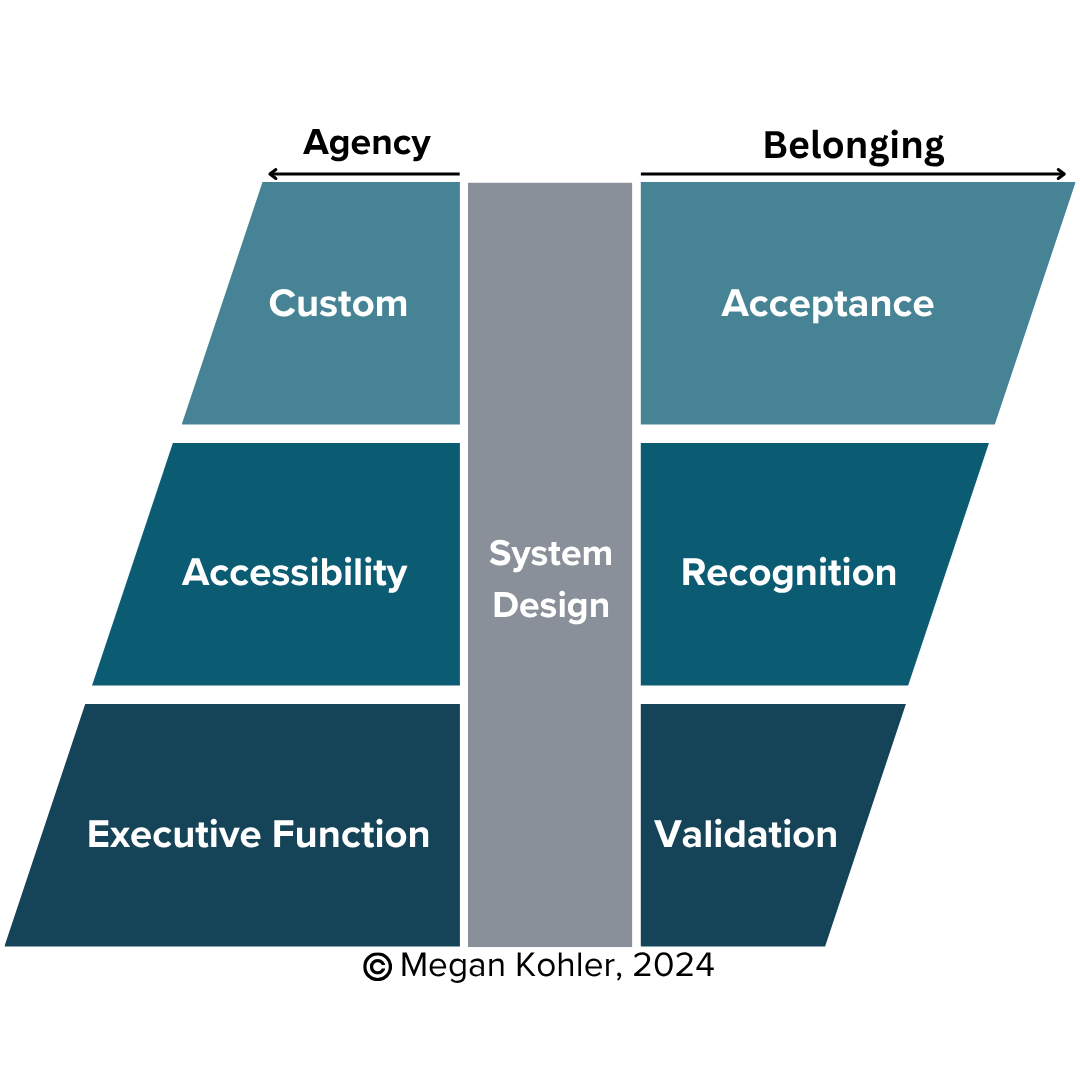
Designing With Neurodivergent Learners, Not Simply for Them

A recent conversation about designing for neurodivergent learners left me thinking about how easily inclusion can remain an aspiration without becoming a consistent practice.

We often approach accessibility through standards, accommodations, and compliance. Those things matter, but neurodivergent learners invite us to consider a broader question: What if the difficulty is not located entirely within the learner? What if some of it is produced by how we design courses, communicate expectations, measure participation, and define success?

A course may technically be accessible while still demanding an exhausting amount of interpretation. Learners might encounter unclear instructions, inconsistent layouts, unnecessary time pressure, sensory overload, rigid participation requirements, or assignments that measure executive functioning as much as subject knowledge.

This challenges us to move beyond asking whether students can access our courses. We also need to ask what our courses require students to overcome before meaningful learning can begin.

At the same time, there is no single neurodivergent learner. A design decision that supports one person may create friction for another. More structure can provide security, but too much can feel restrictive. More choice can create agency, but it can also create decision fatigue. Recorded lectures may offer flexibility while introducing new difficulties with attention and processing.

There may not be one perfectly inclusive design. The goal may be to create thoughtful pathways that give learners greater clarity, flexibility, and control without leaving them to assemble the learning experience on their own.

Productive Challenge or Unnecessary Difficulty?

The conversation also made me think about Vygotsky’s concept of the zone of proximal development. This is the space between what a learner can accomplish independently and what becomes possible with appropriate guidance and support.

In education, we sometimes assume that difficulty is evidence of rigor. But not every difficulty contributes to learning. A student may be capable of engaging deeply with complex ideas while struggling with ambiguous directions, rigid time limits, sensory demands, or the executive functioning required to manage several overlapping tasks. These barriers can push a learner outside a productive learning zone without increasing the intellectual value of the experience.

This raises an important design question: Are we challenging students through the substance of what they are learning, or through the conditions we have constructed around that learning?

For neurodivergent learners, scaffolding might include predictable course structures, models of completed work, opportunities to practice before being evaluated, explicit explanations of expectations, flexible ways to participate, or tools that support planning and processing.

These supports do not remove rigor. They can make the intended rigor more reachable by directing the learner’s effort toward the knowledge or skill the course is meant to develop.

The zone of proximal development also reminds us that appropriate support cannot be entirely standardized. The distance between independence and supported possibility will differ from one learner to another. It may also change across tasks, environments, and moments in a student’s life.

Designing for that variability requires more than adding a fixed collection of accommodations. It requires learning environments that help students recognize what support they need and access it without stigma.

Designing With Learners

Another important consideration is the difference between designing for neurodivergent learners and designing with them.

It is easy for educators and instructional designers to make assumptions about what students need. Even well-intentioned assumptions can reduce people to diagnoses or generalized profiles. Listening, testing, and inviting learners into the design process can reveal barriers that experts may never notice.

However, this creates another responsibility. We should not expect neurodivergent students to repeatedly disclose personal information, represent an entire community, or educate the institution without recognition and support. Meaningful participation must be invited in ways that protect privacy and respect the value of students’ contributions.

Questions I Am Still Considering

The conversation left me with several questions:

  1. Are we challenging students through the substance of the learning, or through unnecessary barriers created by our course design?
  2. How can we distinguish productive struggle within a learner’s zone of proximal development from difficulty caused by an inflexible learning environment?
  3. Which course practices measure actual learning, and which primarily measure executive functioning, processing speed, social comfort, or tolerance for ambiguity?
  4. How can we design with neurodivergent learners without requiring them to disclose personal information or repeatedly educate the institution?
  5. Who gets to define what meaningful participation, engagement, and success look like?

That final question feels especially important. In education, we can unintentionally privilege the learner who responds quickly, speaks comfortably in groups, maintains eye contact, processes information in familiar ways, and demonstrates attention in visible forms. When those behaviors become proxies for engagement, we risk misunderstanding students whose learning is real but expressed differently.

Designing for neurodivergent learners is not about lowering expectations. It is about becoming more precise about which expectations genuinely serve learning. It asks us to preserve meaningful challenge while removing friction that contributes little to the intended outcome.

Perhaps rigor should not be measured by how much difficulty a student can endure independently. A better measure may be the depth of learning students can reach when challenge and support are intentionally designed to work together.

This work requires more than adding accommodations after barriers appear. It requires curiosity about the assumptions embedded in our courses and humility about how much we still need to learn.

Perhaps the most useful starting point is not, “How do we help neurodivergent students succeed in the courses we have designed?”

It may be, “What can neurodivergent learners teach us about designing better learning environments for everyone?”

How My Brain Learned to Let Go

Nine sessions.

Each one quiet on the outside.

Each one seismic on the inside.

A few people have ask what changed.

I struggle to answer because the experience did not feel like learning something new.

It felt like my brain finally stopped gripping the same old grooves it had been trapped in for decades.

I did not feel “high.”

I did not see dramatic visions.

I felt space.

Mental space.

Emotional space.

Just enough room for something deeper to shift.

For months, I could not explain why it helped.

Then I watched a video by Chase Hughes titled “Neuroscience JUST Did the IMPOSSIBLE.”

You can watch it here:

As he walked through recent neuroscience research, something clicked.

Not metaphorically.

Mechanistically.

Here is the simplest way I can explain it.

Your brain is not just a collection of thoughts.

It is a living network of connections.

Those connections decide:

  • What you notice
  • What you ignore
  • What feels dangerous
  • What feels possible

When you live with depression, trauma, or chronic anxiety, the problem is not weak willpower.

The problem is that certain brain networks keep talking to each other in the same tight loops, long after those loops stopped being useful.

Think of it like this.

  • The same roads get driven every day
  • Other roads slowly disappear
  • Flexibility is lost

That is what I felt stuck inside before ketamine.

In the video, Chase explains research showing that mental experiences leave reliable signatures in brain activity. Using advanced brain imaging and AI, scientists can reconstruct rough images of what a person is seeing based only on neural data.

Not in a sci-fi way.

In a pattern-recognition way.

That matters because it tells us something important.

Inner experience is not vague or mystical.

It is physical.

It lives in circuits.

And circuits can change.

The second piece of research he discusses mattered even more to me.

It comes from a recent paper published in Cell that examined what happens in the brain after a single dose of psilocybin in mice:

Here is the core idea.

Psilocybin did not just activate the whole brain.

It opened a window.

During that window, the networks that were active got rewired.

Some connections strengthened.

Others weakened.

And the pattern depended on which brain regions were active during the experience itself.

That line stopped me cold.

Because during my ketamine sessions, my brain was not rehearsing shame, fear, or self-attack.

Those loops went quiet.

Instead, other things came online:

  • Sensory awareness
  • Bodily calm
  • Memory without panic
  • Reflection without punishment

The research shows that when those kinds of networks are active during a plasticity window, they are the ones that get reinforced later.

Not forever.

But enough to matter.

Enough to change default settings.

That matches my experience almost exactly.

After the sessions:

  • My thoughts slowed
  • Emotional reactions softened
  • Old triggers lost some grip
  • I had more room to choose my response

Nothing magical happened.

Something biological happened.

The brain regions that usually kept each other trapped in feedback loops loosened their hold.

Other pathways strengthened.

I did not become a different person (or did I?).

I did become less imprisoned by one narrow version of myself.

That is why the therapy mattered.

Ketamine was not the healing.

The context was.

  • Safety
  • Guidance
  • Intention
  • Stillness

The medicine made my brain more willing to update itself.

That is both the promise and the responsibility of this research.

If the brain becomes especially malleable under certain conditions, then the conditions matter deeply.

Healing does not come from chemicals alone.

It comes from what the brain is doing while it is open to change.

That leaves me with a question I still sit with.

If your brain were given a rare window to rewire itself,

what patterns would you want active in that moment?

Fear?

Control?

Or presence, compassion, and truth?

That question is not just about ketamine or psychedelics.

It is about how you live every day.

Why an AI Pendant Can’t Fix Our Loneliness

I spent part of the early morning watching a documentary about the Friend.com pendant, a tiny AI “companion” device that clips to your shirt and promises something bold. Not productivity. Not information. Friendship.

The documentary left me thinking less about the product itself and more about what it reveals about us.

You can decide for yourself whether you’d ever wear something like this. My hope is that you walk away asking deeper questions than “Does it work?”

What the device tries to be

• The pendant uses Claude to send text messages that mimic emotional presence.

• There’s no screen, no speaker, no real interface.

• It connects over Bluetooth and feeds you short replies.

• It claims to offer companionship without pretending to be a tool.

You’re asked to wear it over your heart. That symbolism isn’t subtle.

What people actually experienced

• Most reviewers reported delays, fragmented replies, and strained attempts at emotional intimacy.

• Several described it as “needy.” One person said it felt like wearing a “senile anxious grandmother.”

• It often misread social cues and struggled to respond in real time.

When your friend lives in the cloud, awkwardness becomes a feature, not a bug.

The human behind the hype

• The founder is young, ambitious, and willing to provoke.

• His startup pivots created confusion and doubt.

• His marketing campaign burned through more than a million dollars in New York subway ads.

• Graffiti and public backlash followed, but he welcomed the controversy.

It raises a question: when does a product stop serving people and start serving a narrative?

The privacy tension

• The device listens to your environment.

• Liability shifts to the user.

• The company promises quick data deletion, but trust is already damaged.

If a device meant to offer companionship introduces fear instead of safety, what relationship is it really inviting?

The deeper cultural story

You can’t watch this documentary without reflecting on the larger patterns at work.

• Loneliness is rising, especially among younger generations.

• Many of today’s teens spent formative years isolated during lockdown.

• AI companionship is becoming a serious market, not a fringe idea.

• Some people report psychological strain from forming emotional dependence on AI systems.

The device becomes a symptom. The real story is the ache underneath.

Ask yourself: why are products like this resonating at all?

A growing trend

• Robot pets.

• Sentient-styled chat companions.

• Wearable AI friends.

These aren’t tech novelties anymore. They’re responses to unmet social needs.

We keep trying to automate connection. But connection has never been an efficiency problem.

The ethical crossroads

Every generation invents tools. But some tools reshape the people who use them.

This pendant feels like a reminder that technology often sprints ahead of the human questions it raises.

What do we lose when companionship becomes a product?

What happens to emotional development when we outsource intimacy?

Who gets harmed when we design devices without understanding the psychology they tap into?

I keep thinking about real students, real families, real communities. We thrive through mutual recognition. Through presence. Through shared life.

A pendant can’t do that for you.

What you might ask yourself

• What kind of connection are you actually longing for?

• Who in your life already offers pieces of that connection?

• What practices strengthen your capacity for real relationship?

• How does technology support your formation rather than distort it?

You know your own story better than any device can.

Would I wear it?

No.

But not because it’s clunky or awkward or poorly designed.

I wouldn’t wear it because I want my friendships to shape me.

Not a product.

Your turn

Would you ever wear an AI companion, or does it feel like a distraction from the relationships that matter most in your life?

Reflecting on Why Young Men are Falling Further Behind:

For decades, the stereotype of the out-of-shape man in his 30s living in his parents’ basement was played for laughs. Today, it’s no longer just a joke—it’s a social reality. More than half of men ages 18–30 live at home in the U.S. and Australia. What was once comic relief has become commonplace.

The recent ColdFusion documentary “Why Young Men Are Falling Even Further Behind” explores why this is happening and what it means for society. Watching it left me with a mix of concern and urgency. Here are some of the key insights—and questions—we should be asking.

Education Gaps Start Early

  • Two-thirds of high school top performers are girls, while two-thirds at the bottom are boys.
  • Women are now significantly more likely to earn a college degree in almost every developed nation.
  • Reading readiness is central. Only 29% of boys aged 0–2 are read to daily compared to 44% of girls. That gap sets a trajectory that ripples through academic and social development.

Question: Are we willing to confront how family practices and early education quietly disadvantage boys from the start?

Work and Economic Shifts

  • Traditional male-dominated industries—manufacturing, construction—have declined.
  • Service industries, where communication and relational skills matter most, have surged.
  • Women have entered male-dominated fields, which is good for equity, but it also increases competition for young men who lack preparation for service-oriented careers.

Reflection: The old pathways of “a stable job, a family, and a house” no longer map neatly for young men. What new pathways can we create?

The Loneliness Epidemic

  • In 1990, 55% of men reported six or more close friends. By 2021, that number dropped to 26%.
  • The percentage of men with zero friends rose 500% in the same period.
  • This loss of social capital feeds cycles of isolation, aimlessness, and disengagement from school and work.

Question: What role should schools, communities, and even workplaces play in rebuilding friendship and belonging for men?

Dating and Relationships

  • Nearly 30% of men reach age 40 unmarried today, compared to single digits in the 1970s.
  • Many men report fear of approaching women in the wake of the #MeToo movement. Half of men ages 18–25 say they’ve never approached a woman at all.
  • Meanwhile, dating apps create uneven dynamics: women receive thousands of matches while many men get none.

Challenge: How can young men (and women) learn healthy relational confidence in a culture shaped by fear, digital platforms, and shifting gender expectations?

A Sense of Purpose

Richard Reeves and Scott Galloway argue that young men increasingly feel unnecessary—to their families, their communities, or society. That loss of purpose feeds despair, sometimes with dangerous outcomes. Suicide, overdose, and incarceration rates are dramatically higher among men.

When purpose disappears, unhealthy substitutes emerge. Influencers peddling shallow “masculinity” find a ready audience among young men searching for direction.

What Can Be Done?

The documentary points to promising interventions:

  • Early literacy for boys (prioritize reading between ages 1–4).
  • Mentoring and social-emotional programs (like Chicago’s Becoming a Man).
  • High-quality apprenticeships to create real pathways into work.
  • Male-friendly mental health initiatives to reduce isolation.
  • Recruiting more male teachers, especially in reading and English.

These steps don’t diminish efforts to support women. They acknowledge that equality requires attention in both directions.

Moving Forward

This is not about re-establishing old hierarchies. It’s about recognizing where young men are faltering and asking how we can create systems that help them flourish.

  • What if we delayed school entry for boys to account for slower brain development?
  • What if we reimagined literacy practices at home, encouraging fathers to read to sons?
  • What if we built cultural permission for men to need friendship and seek help?

Final Thought

The crisis facing young men isn’t a niche issue. It’s a social one. A society where men are aimless, isolated, and undereducated is one where everyone loses. The good news is that solutions exist—if we’re willing to look honestly at the problem and commit to change.

When Study Mode Arrived… on My Birthday

On July 29, 2025—yes, happy belated birthday to me—OpenAI surprised us all by launching Study Mode in ChatGPT. It wasn’t just any release; it felt like a landmark moment: the AI stepping off the answer-delivery stage and sliding into a Socratic, tutor‑in‑your‑pocket role. The tool intentionally introduces friction—nudging learners to think, reflect, and engage rather than just skim the back of the math book for answers.

What the Heck Is Study Mode, Anyway?

Fast-forward through the rollout to real use:

  • It asks questions to understand your level and goals, scaffolding responses bit by bit.
  • It throws in quizzes or open‑ended prompts to check understanding.
  • And yes, it still lets you bail out and get the swift answer—but it gently reminds you you’re here to learn.

Reviewers give it a cautious nod of approval—especially for STEM. One author praised how it resisted giving answers and kept them thinking, even through quantum mechanics.

The Old You vs. Study Mode: Temptation in the Back of the Book

You remember that when you were younger, you’d sneak a peek at the answers in the back of the book—not because you didn’t want to learn, but because you hit a wall. Temptation won. Study Mode flips that script; when you ask for the answer, it pushes back:

“I’m here to help you learn, not just give you the answer.”

In essence, it’s built to teach how to think, not what to think. But here’s the sticky part: that toggle is a click away. Always.

WIRED warns of just that risk: younger students, still building their self‑control, may simply click out of Study Mode to get that quick solution.

Can This Be Designed For—or Must It Be Instilled?

Merrill’s First Principles remind us: meaningful learning happens when learners are engaged in solving real tasks, when they receive guidance, and when they reflect on their thinking. Study Mode introduces those exact principles—scaffolded tasks, Socratic guidance, reflection checkpoints.

But here’s the heart of it: Technology can nudge, but it can’t reinforce resolve. You need both:

  • Designed-in friction: Study Mode gives students structure and prompting.
  • Learner mindset: It’s up to you (or your students) to stay curious, resist the shortcut, and do the real work—because the reward isn’t a grade—it’s the habit of thinking deeply, which stays with you forever.

As Leah Belsky, OpenAI’s VP of Education, framed it: when the tool is used as a tutor and not just an answer engine, it can significantly improve academic performance.

A Little Birthday Lesson, Gift Wrapped

So, as Study Mode debuted on my birthday, here’s my gift to you (and your blog readers): a reminder that true learning isn’t about speed—it’s about depth. ChatGPT’s new mode can be designed to foster thinking, and we can equip learners to choose that path. But the real magic—where understanding sticks—is when the learner refuses the shortcut, stays curious, and decides to think for themselves. And no AI can take that away from you.

What Are We Really Automating?

A Response to Punya Mishra on AI and Creativity

My friend and colleague Dr. Punya Mishra recently gave a talk on generative AI and creativity that was full of insight, humor, and challenge. You can always count on Punya to make you laugh and think at the same time—and this talk was no exception.

He described generative AI as a “smart, drunk, biased, and supremely confident intern,” which might be the most accurate (and entertaining) description I’ve heard yet. He also shared inspiring examples of using AI to create poems, music, interactive simulations, and visual art—most of which he had no technical background to build from scratch.

His point was clear: when accuracy doesn’t matter, and when we come to AI as curious, creative teachers and designers, something genuinely exciting can happen.

But as I listened, I also found myself wondering about some deeper and maybe less comfortable questions—questions that I think we, as educators and designers, need to be asking ourselves more often.

1. Are We Outsourcing Emotional Labor?

Punya noted a recent trend: users increasingly turning to AI not for ideas, but for therapy and companionship. In fact, “companionship” has now surpassed “idea generation” as the top reason people use chatbots like ChatGPT.

That gives me pause.

Are we outsourcing our need to be heard and known to something that can only mimic understanding? What does that do to our capacity for genuine human connection, especially for young people already navigating digital saturation and identity formation?

Is AI becoming not just a tool but a substitute relationship?

2. What Kind of Creativity Are We Valuing?

Punya showed how AI can help us make things—quickly, beautifully, and in many styles. But I wonder if that ease could quietly reshape our definition of creativity itself.

Are we drifting toward creative outputs that machines are good at—things with recognizable form, familiar rhythm, predictable elegance?

What about the messy, uncertain, deeply human kinds of creativity that resist polish and take time? Do we risk optimizing for style over substance?

3. What Happens When AI Becomes Our Co-Teacher?

Many educators are now using AI for lesson planning, quiz generation, grading, and feedback. On the surface, that sounds efficient. But efficiency can be a trap.

If AI takes over the design work, what happens to our joy in teaching? Our intellectual ownership? Our sense of craft?

Do we begin to devalue deep reflection and slow pedagogical thinking simply because the “intern” is always ready with a faster answer?

4. Who Gets Left Out of This Future?

It’s easy to celebrate these tools when you’re a well-resourced, tech-savvy, curious educator. But not everyone has the time, bandwidth, or institutional support to explore AI in this way.

Whose voices are reinforced by AI, and whose are distorted or erased? What cultural assumptions are baked into the systems we’re now treating as co-authors and collaborators?

If we don’t wrestle with those questions, are we just building another layer of inequality into education?

5. What Should Never Be Automated?

Here’s the questions I keep returning to:

What if the real danger isn’t the tool—but the logic behind it?

The idea that everything complex should be made frictionless?

As someone who works in the world of learning experience design, I spend much of my time helping people navigate ambiguity, uncertainty, and growth. These are not processes we should automate. These are deeply human experiences we need to protect.

Punya’s talk reminded me of what’s possible. This response is a way of holding space for what’s at stake.

Let’s keep building with these tools. But let’s also keep asking the harder questions.

Not because we’re afraid of AI.

But because we care about what it means to be fully human.

High Five 4000: My Favorite Middle Finger at the Gallery

This afternoon, I walked into The Gallery at Washtenaw Community College expecting to see paintings, maybe a few sculptures, something that might make me think or slow down.

I didn’t expect to be applauded by a rubber hand on a stick.

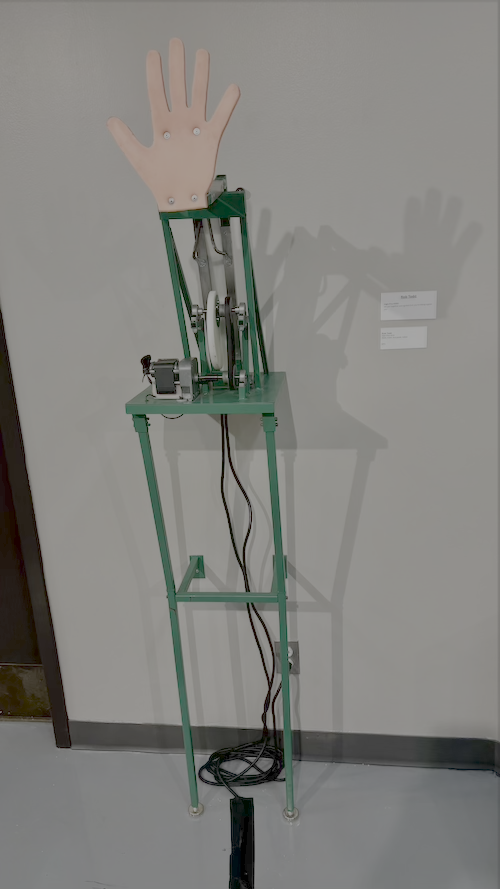
And yet, there it was: Rob Todd’s High-Five 4000. A simple green metal frame, a foot pedal, a motor, a gear, and a soft rubber hand poised and ready for action. Tap the pedal, and whap—you’ve been affirmed.

Sort of.

The placard next to the piece reads:

“We got together and agreed that you’re doing a great job!”

It’s brilliant. It’s savage. It’s hilarious. And it says more about modern work culture than a hundred TED Talks.

This is not a machine that celebrates you. This is a machine that mimics celebration. It parodies the way we’ve automated everything—even encouragement.

The High-Five 4000 doesn’t care how you’re doing. It was built not to care. That’s the point. It’s the kind of machine you might find in the break room of a tech startup where no one knows your name but your Slack bot says “Nice work!” when you check off a Jira ticket.

Honestly, it feels like a rage-against-the-machine punk anthem in visual form. Quiet and motionless until you press the pedal—then it springs to life with the emotional depth of a golf clap.

And I love it.

Because under the surface humor is a sharp critique: we’ve industrialized affirmation. Outsourced the high five. And called it morale.

This thing could sit on the 18th hole with the white-collar bros toasting quarterly gains they had nothing to do with. It could be installed in HR departments across America where we confuse policies with care.

But maybe—just maybe—it also reminds us that a real high five still matters. That humans were never meant to automate encouragement. That someone looking you in the eye and saying, “You’re doing a great job,” still means something.

And maybe it takes a fake rubber hand to help us remember that.

Looking Back to Look Forward: My Journey Through MSU

In 2012, I joined Michigan State University with high hopes and a deep desire to grow. Thirteen years later, I’m preparing to leave my staff role with a mix of gratitude, reflection, and anticipation for what’s next.

MSU gave me more than just a job. It gave me space to explore who I was as a learning experience designer, educator, and mentor. I worked across colleges and departments, helping to build programs, courses, and communities that I believed in. I met people who shaped me—mentors, collaborators, and friends—many of whom stood by me not just professionally, but personally as I navigated serious health challenges over the years.

But it wasn’t always easy. I experienced real disappointment. At times, I was passed over for promotions that I had worked hard for. The way some of those decisions were made felt deeply discouraging and left me questioning my value. Those moments pushed me to confront not just my workplace identity, but also deeper parts of my sense of self-worth.

Looking back, I realize I didn’t always advocate for myself well. I poured my energy into the work, believing that excellence would speak for itself. But I’ve come to understand that in large systems, advocacy matters. Visibility matters. And that doesn’t have to mean self-promotion—it can mean narrating your contributions with integrity, inviting others to see what you see.

Now, I step into a new role at Washtenaw Community College. I’m not just changing jobs—I’m stepping into a season where I hope to lead with clarity, humility, and deep care. I want to build trust with my new team. I want to learn what drives them, what they hope for, and how I can support their growth—personally and professionally.

And even as I leave MSU as a staff member, I remain a part of this community. I’m continuing my PhD in the HALE program, where my research on learner engagement and online course quality still energizes me. I hope to stay connected to the friends and mentors here who’ve made this such a rich chapter of my life.

I carry a lot with me from my time at MSU: lessons, scars, friendships, and gratitude.

To everyone who’s walked part of this journey with me—thank you.

Let’s keep learning, together.

—Dave

From Spartan Roots to New Horizons: A Reflection on My Time at MSU

Since 2012, I’ve had the honor of working with some of the most dedicated, creative, and resilient educators I’ve ever known at Michigan State University.

As I transition into a new chapter—serving as the Director of Instructional Design and Digital Learning at Washtenaw Community College—I’m taking a moment to reflect on what this past decade has meant to me.

What I’m Grateful For

MSU gave me more than a job. It gave me a space to grow, experiment, and connect.

I’m especially thankful for the professional development opportunities that allowed me to:

  • Present at national OLC conferences
  • Help shape and co-lead forward-thinking conference formats like the Technology Test Kitchen and the Innovation Lab (and podcast)
  • Co-create one of my favorite contributions: morning meditation sessions—small but meaningful spaces of reflection and peace during high-energy events

Projects That Shaped Me

Over the years, I’ve had the chance to collaborate on projects that stretched my thinking and enriched the lives of others:

  • The Zombie Apocalypse Course, a playful but powerful model of scenario-based learning
  • REAL Classroom Academy faculty workshops, focused on meaningful instructional spaces
  • Faculty Learning Communities that fostered deep dialogue
  • The creation and launch of The Hub for Innovation in Learning and Technology
  • Curriculum reinvention efforts with the College of Veterinary Medicine
  • Supporting the STEM Building campaign, from visioning to design
  • Helping stand up the Center for Teaching and Learning Innovation, including our podcast-ready recording studio, the HushPod
  • Collaborating on multiple Coursera courses that reached thousands
  • Contributing to the growth of Open Educational Resources (OER) at MSU
  • Participating in mentoring—on both sides of the table
  • Advancing my own scholarship in the HALE PhD program (ABD and counting)

These opportunities allowed me to practice what I believe: that thoughtful design, grounded in real human needs, can change lives.

The Context We Navigated

All of this happened during a time of unprecedented institutional challenge. The complexity, turbulence, and heartbreak of these past years aren’t easy to put into words.

But what stays with me most is the resilience of the Spartan community—the way colleagues continued to show up, ask hard questions, and carry the work forward.

There is a real kind of brilliance here. Quiet. Grounded. Persistent.

That’s why I’ll always consider myself a Spartan, no matter where I go.

Looking Ahead

As I begin this new chapter at WCC, I’m eager to learn from a new group of educators—those equally committed to the work of teaching and learning.

I carry with me everything MSU has taught me:

  • The value of curiosity
  • The power of collective imagination
  • And the belief that learning design is most alive when it is human-centered

There’s much still to do. And I’m grateful to keep doing it.

—Dave Goodrich