
Designing for Engagement, Designing for Connection

Caroline Chance’s recent Online Learning Consortium article, “From Isolation to Connection: Practical Approaches to Minimize Loneliness Among Students in Digital Classrooms,” resonates strongly with the questions at the center of my dissertation research. Chance argues that loneliness is not an inevitable feature of online learning. Through intentional course design, meaningful interaction, instructor presence, and institutional support, online environments can become places of genuine connection.

My research approaches this broader conversation from a different direction. I am examining how LMS-based behavioral engagement metrics differ descriptively between students enrolled in Quality Matters-certified and non-QM online sections of the same course. While Chance focuses on loneliness, belonging, and connection, my study focuses on observable student behaviors within the learning management system. Both begin with a similar premise: course design matters, and its effects may become visible in how students participate in an online course.

Where the Article and My Research Connect

One of the clearest connections is the emphasis on intentionality. Chance describes instructor presence, transparent course structure, early low-stakes interaction, purposeful discussion, and well-supported collaboration as design choices that can help students feel that they belong. These practices overlap with principles embedded in the Quality Matters framework, particularly clear navigation, alignment, learner interaction, support, accessibility, and transparency.

The article also reinforces the importance of looking beyond access. Enrolling students in an online course and giving them access to content does not guarantee that they will feel connected to the learning community or meaningfully engage with the course. An online course can be technically complete and still feel like a content repository rather than a community.

That distinction is central to my interest in engagement. Quality assurance frameworks help institutions evaluate whether important course design features are present. Behavioral data may offer another perspective by showing what students actually do within those environments. Do they access course materials regularly? Do they participate in discussions? Do they complete activities? Do patterns differ between courses that have and have not completed a formal QM review?

Chance’s emphasis on interaction quality is especially important. A required discussion post may produce a measurable LMS event, but that event does not tell us whether the student experienced meaningful dialogue. A reply written only to satisfy a rubric is behaviorally visible, yet it may do little to reduce loneliness or build community. Engagement counts can identify activity, but they cannot fully explain the meaning or value of that activity.

Important Differences

The similarities are useful, but the differences are equally important.

First, loneliness and belonging are not the same as behavioral engagement. Loneliness is an affective and relational experience. Belonging involves whether students feel recognized, valued, and part of a community. LMS metrics capture actions such as logins, content access, assignment activity, or discussion participation. These behaviors may be related to belonging, but they are not direct measures of it.

A student may log in frequently because the course is confusing. Another may participate minimally in the LMS while still feeling connected through a study group, text messages, or interactions outside the platform. Behavioral traces can reveal patterns, but they cannot tell the whole story of a student’s experience.

Second, the article brings together course design, teaching practice, and institutional support. My study is much more narrowly focused. QM certification primarily evaluates the design of a course. It does not guarantee how an instructor will facilitate that design during a particular semester, nor does it measure advising, tutoring, co-curricular communities, or other institutional relationships described in the article. Instructor announcements, personalized outreach, and the facilitation of discussions may substantially affect engagement even when the underlying course design remains unchanged.

Third, Chance’s article is practical and prescriptive. It recommends approaches that educators and institutions can use to foster connection. My study is descriptive and observational. It can identify differences in engagement patterns between the selected QM-certified and non-QM sections, but it cannot establish that QM certification caused those differences. Historical context, instructor practices, student characteristics, semester conditions, and variations in how the course was implemented may also matter.

Finally, the article raises a measurement challenge for quality assurance work. If the goal is genuine connection, should success be measured only through visible participation? A course may generate many discussion posts without producing meaningful relationships. Conversely, a well-designed course may support connection in ways that are not captured by standard LMS data. Quantity is easier to measure than quality, but it may also be less important.

What This Adds to My Thinking

This article reminds me that behavioral engagement should not become an endpoint in itself. Login frequency, participation, and content activity matter because they may represent opportunities for learning and connection. The numbers become meaningful only when interpreted within the design and human experience of the course.

It also suggests a larger conceptual pathway worth exploring:

Intentional course design may create opportunities for interaction. Those opportunities may influence students’ behavioral engagement. Meaningful engagement may then contribute to connection, belonging, persistence, and learning.

My dissertation addresses only part of that pathway. Its contribution is not to prove that QM certification creates belonging, but to examine whether different course-design conditions are accompanied by different patterns of observable engagement. That is a narrower claim, but it may provide a foundation for later research that combines LMS data with student surveys, interviews, or measures of social presence and belonging.

Ultimately, Chance’s article sharpens the question behind my research. We should not evaluate an online course only by asking whether it is organized, accessible, or aligned. We should also ask what that design makes possible for students. Does it invite participation? Does it support meaningful interaction? Does it help students recognize that someone is present, paying attention, and prepared to respond?

Those questions connect quality assurance to something larger than compliance. They connect it to the human purposes of course design.

Questions for Follow-Up and Reflection

  1. Which behavioral engagement metrics are most likely to reflect meaningful interaction rather than simple compliance?
  2. How might measures of belonging, loneliness, or social presence complement LMS data in future research?
  3. Where should we draw the boundary between the effects of course design and the effects of instructor facilitation?
  4. Does QM certification create stronger opportunities for connection, even when those opportunities are not consistently used by students or instructors?
  5. How can institutions evaluate whether online students feel connected beyond the boundaries of an individual course?
  6. If quality assurance frameworks emphasize the presence of interaction, how might they more directly address the quality and relational value of that interaction?
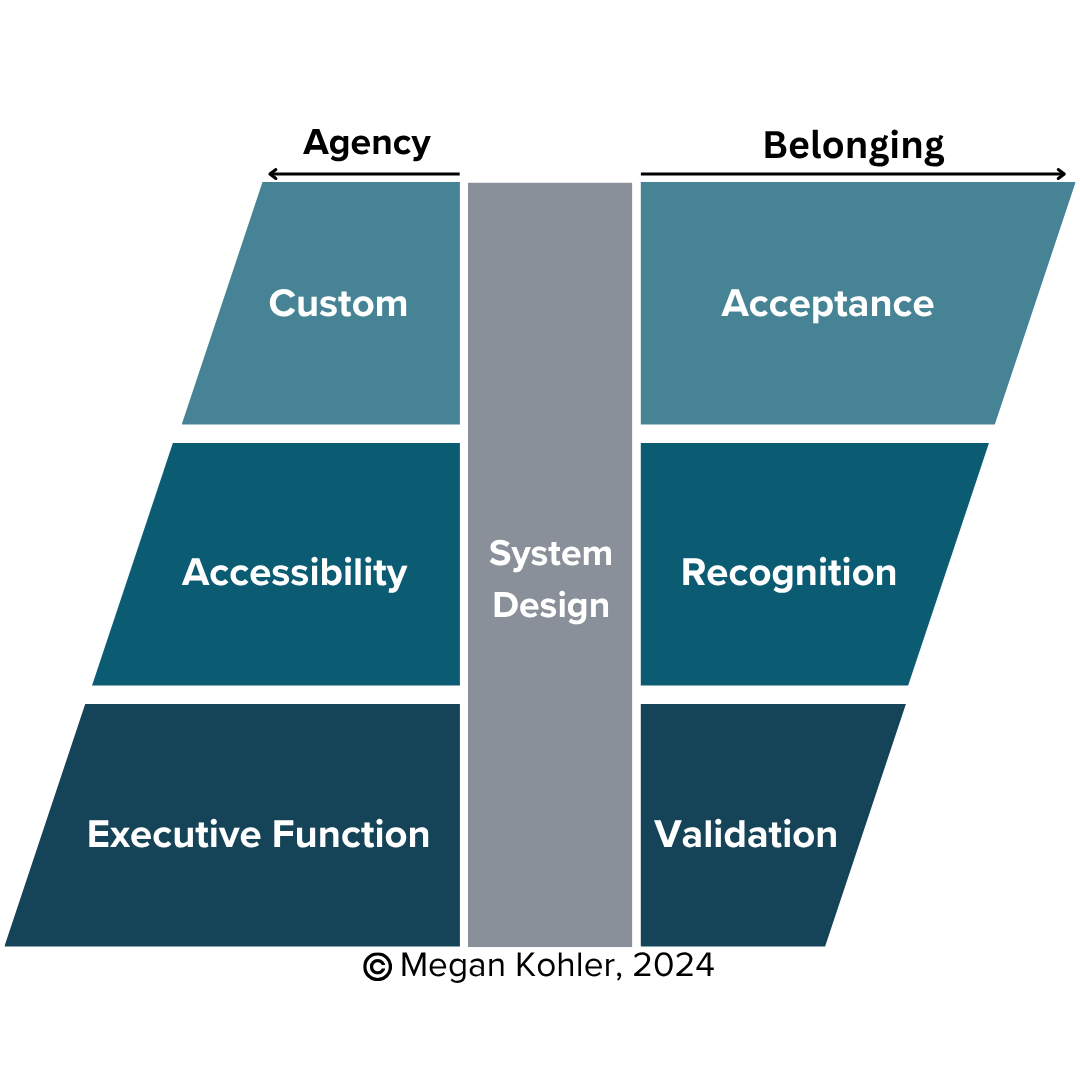
Designing With Neurodivergent Learners, Not Simply for Them

A recent conversation about designing for neurodivergent learners left me thinking about how easily inclusion can remain an aspiration without becoming a consistent practice.

We often approach accessibility through standards, accommodations, and compliance. Those things matter, but neurodivergent learners invite us to consider a broader question: What if the difficulty is not located entirely within the learner? What if some of it is produced by how we design courses, communicate expectations, measure participation, and define success?

A course may technically be accessible while still demanding an exhausting amount of interpretation. Learners might encounter unclear instructions, inconsistent layouts, unnecessary time pressure, sensory overload, rigid participation requirements, or assignments that measure executive functioning as much as subject knowledge.

This challenges us to move beyond asking whether students can access our courses. We also need to ask what our courses require students to overcome before meaningful learning can begin.

At the same time, there is no single neurodivergent learner. A design decision that supports one person may create friction for another. More structure can provide security, but too much can feel restrictive. More choice can create agency, but it can also create decision fatigue. Recorded lectures may offer flexibility while introducing new difficulties with attention and processing.

There may not be one perfectly inclusive design. The goal may be to create thoughtful pathways that give learners greater clarity, flexibility, and control without leaving them to assemble the learning experience on their own.

Productive Challenge or Unnecessary Difficulty?

The conversation also made me think about Vygotsky’s concept of the zone of proximal development. This is the space between what a learner can accomplish independently and what becomes possible with appropriate guidance and support.

In education, we sometimes assume that difficulty is evidence of rigor. But not every difficulty contributes to learning. A student may be capable of engaging deeply with complex ideas while struggling with ambiguous directions, rigid time limits, sensory demands, or the executive functioning required to manage several overlapping tasks. These barriers can push a learner outside a productive learning zone without increasing the intellectual value of the experience.

This raises an important design question: Are we challenging students through the substance of what they are learning, or through the conditions we have constructed around that learning?

For neurodivergent learners, scaffolding might include predictable course structures, models of completed work, opportunities to practice before being evaluated, explicit explanations of expectations, flexible ways to participate, or tools that support planning and processing.

These supports do not remove rigor. They can make the intended rigor more reachable by directing the learner’s effort toward the knowledge or skill the course is meant to develop.

The zone of proximal development also reminds us that appropriate support cannot be entirely standardized. The distance between independence and supported possibility will differ from one learner to another. It may also change across tasks, environments, and moments in a student’s life.

Designing for that variability requires more than adding a fixed collection of accommodations. It requires learning environments that help students recognize what support they need and access it without stigma.

Designing With Learners

Another important consideration is the difference between designing for neurodivergent learners and designing with them.

It is easy for educators and instructional designers to make assumptions about what students need. Even well-intentioned assumptions can reduce people to diagnoses or generalized profiles. Listening, testing, and inviting learners into the design process can reveal barriers that experts may never notice.

However, this creates another responsibility. We should not expect neurodivergent students to repeatedly disclose personal information, represent an entire community, or educate the institution without recognition and support. Meaningful participation must be invited in ways that protect privacy and respect the value of students’ contributions.

Questions I Am Still Considering

The conversation left me with several questions:

  1. Are we challenging students through the substance of the learning, or through unnecessary barriers created by our course design?
  2. How can we distinguish productive struggle within a learner’s zone of proximal development from difficulty caused by an inflexible learning environment?
  3. Which course practices measure actual learning, and which primarily measure executive functioning, processing speed, social comfort, or tolerance for ambiguity?
  4. How can we design with neurodivergent learners without requiring them to disclose personal information or repeatedly educate the institution?
  5. Who gets to define what meaningful participation, engagement, and success look like?

That final question feels especially important. In education, we can unintentionally privilege the learner who responds quickly, speaks comfortably in groups, maintains eye contact, processes information in familiar ways, and demonstrates attention in visible forms. When those behaviors become proxies for engagement, we risk misunderstanding students whose learning is real but expressed differently.

Designing for neurodivergent learners is not about lowering expectations. It is about becoming more precise about which expectations genuinely serve learning. It asks us to preserve meaningful challenge while removing friction that contributes little to the intended outcome.

Perhaps rigor should not be measured by how much difficulty a student can endure independently. A better measure may be the depth of learning students can reach when challenge and support are intentionally designed to work together.

This work requires more than adding accommodations after barriers appear. It requires curiosity about the assumptions embedded in our courses and humility about how much we still need to learn.

Perhaps the most useful starting point is not, “How do we help neurodivergent students succeed in the courses we have designed?”

It may be, “What can neurodivergent learners teach us about designing better learning environments for everyone?”

The Future of AI Voices: A Story, A Shock, and A Question

Um. Hi. Yeah, it’s me. It’s been a while, I know. A lot has happened.

So, where to begin?

How about a quick story—something that felt strangely destined to happen and still has me questioning its implications for humanity?

Melodramatic much?

Welcome to the brain of Dave Goodrich.

But I digress.

A Throwback to the Amiga 500

Commodore Amiga 500, 16-bit computer (1987)

When I was about the age of my oldest son, Gibson—who’s 14 and about to enter high school—someone gifted our family an Amiga 500. We had no clue what it was, so by default, it became mine.

One of its coolest features? Text-to-speech. I could type something, and the computer would read it back to me. Mind. Blown. That moment sparked a lifelong fascination with speech synthesis.

Since then, I’ve used text-to-speech (TTS) technology almost daily for nearly two decades. It’s been a game-changer for my reading habits, my studies, and my ability to consume content on the go.

A few of my go-to tools:

  • Apple products (built-in screen readers)
  • Voice Dream (a fantastic mobile app for reading PDFs, articles, and books)
  • Speech Central (another great TTS app)

But this week, I had an experience that shook my assumptions about AI voices.

A Conversation That Changed Everything

I was having lunch at MSU’s library when I overheard two people engaged in a deep, heartfelt conversation. The way they laughed, paused, and responded to each other—it was something only humans could do. Right?

I thought to myself:

“There is no way AI voices will ever capture this kind of emotional nuance.”

Two hours later, I stumbled upon a video of a guy chatting with an AI-generated voice on a website called Sesame.com.

I couldn’t believe my ears.

The AI’s voice wasn’t just realistic—it had tone, pacing, and personality. It sounded… human.

Then, my colleague Jay mentioned that you can upload PDFs to Notebook.LM and generate an AI-voiced podcast of the content. Curious, I took the terms of service from Sesame.com, fed them into Notebook.LM, and—boom—I had a surprisingly engaging podcast about terms of service.

Seriously. It was interesting. It was entertaining.

And it got me thinking…

What Happens Next?

  • How does this technology make you feel?
  • How could AI-generated voices be used for good?
  • How could they be misused?
  • How do we embrace innovation while protecting ourselves from its risks?

I don’t have all the answers. But I do know this—things are changing fast, and we need to pay attention.

What do you think?

Just Another Dave: Unpacking Copyright in Podcast Episode 001

just another dave…

Welcome to the very first episode of “Just Another Dave,” a podcast that explores the complex and often perplexing world of copyright. A special thanks to Tracy Balduzzi, a people connector and aspiring world traveler from Syracuse University who I met last week at OLC Accellerate in Washington D.C. and who encouraged me to do this. I honestly wouldn’t have without her nudging. So, thank you. In this inaugural episode, we delve into the age-old wisdom of “nothing new under the sun” and examine how copyright intersects with our quest for knowledge and creativity.

Episode 001 Outline

Nothing New Under the Sun

I start by contemplating the ancient wisdom of Ecclesiastes 1:9, which reminds us that there is “nothing new under the sun.” This timeless concept lays the foundation for our discussion on copyright, where the old meets the new.

Re:mix Assignment

Reflecting on my recent experiences in school, I discuss the “re:mix assignment,” wondering if I should be taking courses I have taught before. I’m wondering about the importance of honesty about my learning journey being key as I explore the evolving landscape of copyright. I resonate with Ecclesiastes 1:18, which warns that “the more knowledge, the more grief.”

The Internet’s Own Boy

In this section, I link copyright to the story of “The Internet’s Own Boy,” underlining the significance of intellectual property and how knowledge can sometimes bring misery.

Imposter Syndrome

I explore the concept of imposter syndrome in the context of copyright, discussing the challenges of individuality, standing out in the world, and the multiplicity of ideas that share the same name. I’m pondering the age-old questions: “Who am I?” and “Where did I come from?” and “Where am I headed?”

Artificial Intelligence

I begin a very brief dive into the questions raised when we explore the implications of artificial intelligence on copyright and intellectual property.

All Things New

I wrap up by reflecting on the idea of singing “to the Lord a new song” and the potential for innovation and change in the realm of copyright.

Bob Dylan

Finally, I conclude with an inspirational Bob Dylan video that echoes the themes of creativity and originality in the world of music and art.

Conclusion:
Join me on this intellectual journey as I embark on “Just Another Dave.” In this podcast, I’ll explore the intersections of copyright, education, and technology, drawing on timeless wisdom, modern insights, and thought-provoking discussions. Stay tuned for future episodes that promise to be as honest and raw as they are entertaining.

It’s Hybrid Eve!! #MAET

You know those butterflies you used to get before the first day of school?

I wish someone had told me those never go away.

I’m so excited about tomorrow being the first day of a six week learning journey with the MAET Hybrid year two cohort and my co-instructor Brittany (who is so phenomenal). I just finished watching some introductions that some of the educators recorded on our Flipgrid wall. I am so thrilled and honored to get to learn from and with this community!

Tomorrow is a big day with a lot of important ground to cover in ways that will shape the trajectories of the entire learning experience.

So, no pressure, but it is going to be one of the most important days of the experience.

I’m looking forward to learning more about each educator in the community and getting a sense of where they come from and where they are headed in their careers. This (among other things) is a foundational focus of tomorrow that will start off right away in the first meeting bright and early. Brittany and I are going to be facilitating some activities that we have drawn up and have put a lot of planning into them. Here’s to a successful first run at some brand new approaches for reaching the same outcomes of previous years.

It is going to be epic.

Embarking on teaching a nine credit seminar

This is an opening post to a series of daily posts reflecting on my learning as an instructor. This summer, I am teaching an intensive 9 credit hour seminar in 6 weeks on the topics of educational technology, educational leadership, and educational research.

Why do you teach?

I teach to learn. I learn to teach. In some ways, teaching and learning are as natural as breathing. It is essential. It is always happening. Most of the time we aren’t aware that it is happening or appreciative of its importance. I want to study and practice teaching and learning so that I can better understand healthy approaches to it for improving learning experience design.

What’s your next gig?

Next week begins a six week adventure of teaching a nine credit seminar course. This is a mosaic of three courses within the Masters of Arts in Educational Technology program in the College of Education at Michigan State University. It combines courses in educational technology, educational leadership, and educational research. I am excited and nervous.

What are you most excited about?

What I love most about this intensive seminar is it’s convergence within the larger overarching TPACK framework. TPACK has been a cornerstone of the program since it’s inception. It stands for the contextual relationships between three domains of knowledge: technical knowledge, pedagogical knowledge, and content knowledge. As you can see, these three domains match up nicely to the focus of each of the courses in the seminar. In the same way TPACK has a sweet spot in the overlapping circles, this seminar affords a unique advantage of having all three courses interweaved into one common experience.

What makes you nervous?

This high intensity seminar makes me nervous because of all the planning happening in such rapid succession. What helps a great deal is that arrangements have been made for my full-time appointment so that I can focus exclusively on this course for a time. I love where I work and the supportive community that surrounds me each day.

What are you hoping to learn?

This summer, I would like to do a daily recap and reflection on this experience as one of the co-facilitators. It is important that I do this as it is a meaningful learning experience for myself as an educator. Doing so will allow me to have robust notes to remember the things that worked well and the things that can be improved.

What are you hoping educators gain from the seminar?

I would hope that they would remember that good leadership boldly builds on evidence-based practices while simultaneously maintaining humble postures of learning. These practices and mindsets must drive all technical and innovative decisions if there is any chance of them being successful. If the technology alone is expected to lead these conversations, we will inevitably fail. Let the learning commence!

Get serious. Play more.

A quote by a man named Lazer from the 70s got me thinking about science education today.

book coverI love the conversations that happen in The Hub. A few months back, Troy Livingston and I were shooting the breeze and somehow got on the topic of teaching science. Troy recommended a book to me called “Teaching Science to Children” by a guy named Lazer Goldberg. I told him I would read any science book by a guy whose first name is Lazer. The book was first published in 1970, but the content within it feels timeless.

Toward the beginning of the book, a paragraph that jumped out to me as being visionarily prophetic. So much so, I might insinuate that Lazer Goldberg may be viewed as a influencer of science education reform efforts in similar ways that Dr. Martin Luther King was influential to the civil rights movements. The following paragraph gets me fired up about science education in ways that remind me of the reasons I entered into the field in the first place.

“What is wanted is the will to organize a climate for children’s science learning. In such a climate children continue their play. The games whose rules they learn elicit their most intense participation. There is no shame attached to error and failure, and fear has been cast out. Interesting errors are admired, and perceptive questions are applauded. Task governs time, and there is freedom to make, to think, to remake, to chat, and to dream a little. It is a place where dissent and independence are honored, where thought is not deprived of feeling nor art of thought. Above all, it is a place of diverse activity—social, intellectual, artistic, manual. It is a place where children transform bits of their environment and in the process transform themselves.”

I believe that the climate of science learning described here could be applied to any discipline and learning level without sacrificing legitimacy. If we are going to be serious about improving, we need our working and learning environments to be open to more playful energy.

It might seem counterintuitive, but let’s get serious and play more.

If we hold on firmly to our ideas, our practices, our ways of living in this world, this is ironically the quickest way to lose them. If we, instead, play with and hold loosely our ideas, practices and ways of living, this is the only way we find them, grow and move forward toward a brighter future.

Fitness Coaching Failure

{ …commentary on the traditional over-emphasis on the pedagogy of lecture… }

“I stood in front of that class each day for six weeks and demonstrated perfect form in my workouts. They all took great notes. Why didn’t they get in shape?” -Hypothetical Failing Fitness Coach

Man lifts cats as weights
LOL Cat Fitness Fail Shared by James at FITBODYBUZZ

It is a common misperception about teaching that the educators job is solely to instruct. Placing this concept in the context of an athletic or fitness coach can help reveal the flaw in thinking here. It isn’t that demonstrating good form or good practices isn’t important. Quite the contrary. But if that is all that happens without space and feedback provided for people to practice on their own or with others, the value of that instruction is prone to be wasted in the ether.

Eric Westervelt and Carl Wieman ascertain in this NPR Interview that:

“…undergraduate Higher Ed still worships at the old false idol called the Big Lecture and doesn’t seem to want to ask whether it’s working.”

It is possible to be incredibly in shape and fail at helping others to do so.

Similarly, it is possible to be incredibly smart and unable to impart it on others without a fundamental understanding of how people learn.

Let’s get smarter together on our shared values of teaching & learning as educators.

Reflection on Two Friday Talks

I have a habit of putting interesting events and talks coming up on my calendar and then forgetting about them until the day of. A few Fridays back (September 15th) was one of those days where not one, but two speaking events were on my calendar. It was a busy day, but I was glad I stuck with my plan to attend them both.

There are many of these kinds of events I attend that I will duck out of if nothing of importance is being discussed or happening and I will forget about them and get back to my work. This Friday was different. It was a bit of an anomaly of a day because it had two events I had previously signed up for. One was in the morning and the other in the afternoon which allowed me attend both. That itself was unique, but what was far more fascinating to me is that both of the events were so good that five minutes after they began, I started recording them on my phone knowing that there was rich content being shared that was worth pausing and reflecting on further.

Hence this blog post.

The events were called:

  1. Knowledge for Sale
  2. STEM Alliance Fall Reception

Dr. Busch shares his book conclusions with a room of peopleKnowledge for Sale

Friday morning I attended “Knowledge for Sale: The Neoliberal Takeover of Higher Education”. This was a talk given by Dr. Lawrence Busch who is a Distinguished Professor Emeritus in the Department of Sociology. In the talk, Dr. Busch discussed the contents and premise of his new book in this same title. Here, Busch espouses that higher education has been taken over by a newer pragmatic and market driven philosophy compared to its more historic roots in pursuing knowledge for its own sake.  As he spoke, I couldn’t help but make connections to so many instances and efforts globally in higher education and surrounding me in my own context here in Michigan. I wash shocked by the low number of attendees for this talk and wished as I was listening that the whole university was present. Instead, I decided to hit record about 5 minutes into the talk so that I could share it with others who I knew were interested in attending, but who were unable to (see the link below this section). I have added the book to my Amazon wish list and look forward to reading it this Fall. I’m sure it will continue to give me a lot to chew on related to some of the powerful and yet often invisible forces at work behind the scenes in higher education.

The talk was followed up by a couple of commenters who both reinforced some of the things Dr. Busch highlighted and embellished on them in their own experiences shared.  Dr. Alyssa Dunn from the Department of Teacher Education in MSU’s College of Education and Dr. Stephen Gasteyer from the Department of Sociology shared personal accounts of market-driven decisions being made by administrators that were directly effecting the lives and qualities of education they have given their life vocations to. I was particularly struck by the account Dr. Dunn shared of her own experiences at Emory University in Atlanta where entire departments that were reputable for their excellence were eliminated for claimed monetary reasons by administration. These departments included the education program where she earned her masters and doctorate. They also included spanish, liberal arts, and ethnic studies staffed mostly by people of color. Administration further claimed that these programs were not relevant for 21st century education. You can’t make this shit up.

  • Listen to an audio capture of the talk recorded on my phone.

Improving How Universities Teach ScienceSTEM Alliance Fall Reception

Later in the afternoon, I walked over in very hot weather for Michigan to the Kellog Hotel and Conference Center to hear Carl Wieman speak. Dr. Wieman was the 2001 Nobel Prize winner in Physics and has done extensive experimental research in atomic and optical physics. What I was more interested in hearing from him on was with his more recent intellectual focus which is on undergraduate physics and science education. Here, he has been a pioneer for the use of experimental techniques for evaluating the effectiveness for particular teaching strategies in the STEM fields. Among other accomplishments, Carl also recently served as the Associate Director for Science in the White House Office of Science and Technology.

Dr. Wieman spoke on “Taking a scientific approach to the learning and teaching of science.” The focus of his work draws on research on how people learn informing more effective ways to learn, teach, and evaluate learning than what is in use in the traditional college class. He shared his slides freely where he points to examples of some of his work with places such as MSU, U. Cal. San Diago, Univ. of British Columbia, Stanford and others. He pointed to a meta analysis of approximately 1,000 research studies from undergraduate science and engineering classrooms comparing traditional lecture with “scientific teaching” approaches. He went on to explain that the more scientific approaches to teaching consistently demonstrate greater learning outcomes, lower failure rates, and how these benefits extend to all, but most notably to at-risk students. None of these findings were surprising to me in any way, still it is always helpful to have people in the room who are hopefully being persuaded of these things further by evidence.

  • View his slides.
  • Listen to audio of his talk recorded on my phone.

What about you? Have you attended any meaningful talks or workshops lately? Please share your reflections as a follow-up here. I believe that good things were always meant to be shared. 

hello, world!

Gibson and me at Binder Park Zoo
Gibson and me at Binder Park Zoo in Battle Creek, MI

Friends,

They say you are a writer if nothing makes you more excited than a blank page.

Maybe that makes me a writer?

I don’t know, I think a writer is someone who writes and writes often because it is in their bones.

I’m excited to start a brand-new writing and reflective practice here in this space. Much of it will be for my own learning and growth as someone considering the prospects of being a PhD candidate, but I also plan to reflect on my life as a husband, a father, a musician, an educator and a learning designer.

I look forward to connecting with those of you who might join me in the practice of writing as reflection as we trod our learning paths together.

Thanks for stopping by!