Designing With Neurodivergent Learners, Not Simply for Them

A recent conversation about designing for neurodivergent learners left me thinking about how easily inclusion can remain an aspiration without becoming a consistent practice.

We often approach accessibility through standards, accommodations, and compliance. Those things matter, but neurodivergent learners invite us to consider a broader question: What if the difficulty is not located entirely within the learner? What if some of it is produced by how we design courses, communicate expectations, measure participation, and define success?

A course may technically be accessible while still demanding an exhausting amount of interpretation. Learners might encounter unclear instructions, inconsistent layouts, unnecessary time pressure, sensory overload, rigid participation requirements, or assignments that measure executive functioning as much as subject knowledge.

This challenges us to move beyond asking whether students can access our courses. We also need to ask what our courses require students to overcome before meaningful learning can begin.

At the same time, there is no single neurodivergent learner. A design decision that supports one person may create friction for another. More structure can provide security, but too much can feel restrictive. More choice can create agency, but it can also create decision fatigue. Recorded lectures may offer flexibility while introducing new difficulties with attention and processing.

There may not be one perfectly inclusive design. The goal may be to create thoughtful pathways that give learners greater clarity, flexibility, and control without leaving them to assemble the learning experience on their own.

Productive Challenge or Unnecessary Difficulty?
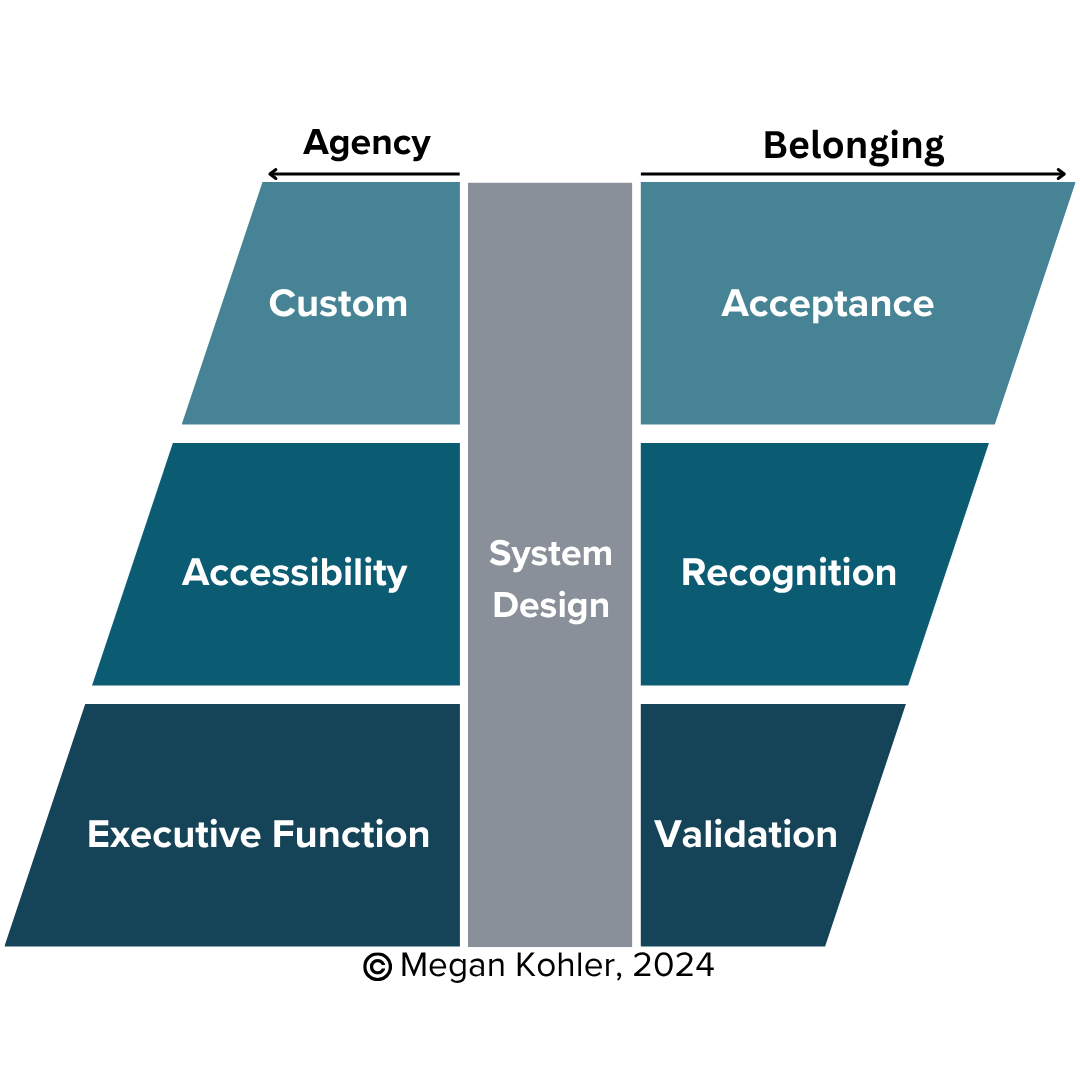
The conversation also made me think about Vygotsky’s concept of the zone of proximal development. This is the space between what a learner can accomplish independently and what becomes possible with appropriate guidance and support.

In education, we sometimes assume that difficulty is evidence of rigor. But not every difficulty contributes to learning. A student may be capable of engaging deeply with complex ideas while struggling with ambiguous directions, rigid time limits, sensory demands, or the executive functioning required to manage several overlapping tasks. These barriers can push a learner outside a productive learning zone without increasing the intellectual value of the experience.

This raises an important design question: Are we challenging students through the substance of what they are learning, or through the conditions we have constructed around that learning?

For neurodivergent learners, scaffolding might include predictable course structures, models of completed work, opportunities to practice before being evaluated, explicit explanations of expectations, flexible ways to participate, or tools that support planning and processing.

These supports do not remove rigor. They can make the intended rigor more reachable by directing the learner’s effort toward the knowledge or skill the course is meant to develop.

The zone of proximal development also reminds us that appropriate support cannot be entirely standardized. The distance between independence and supported possibility will differ from one learner to another. It may also change across tasks, environments, and moments in a student’s life.

Designing for that variability requires more than adding a fixed collection of accommodations. It requires learning environments that help students recognize what support they need and access it without stigma.

Designing With Learners

Another important consideration is the difference between designing for neurodivergent learners and designing with them.

It is easy for educators and instructional designers to make assumptions about what students need. Even well-intentioned assumptions can reduce people to diagnoses or generalized profiles. Listening, testing, and inviting learners into the design process can reveal barriers that experts may never notice.

However, this creates another responsibility. We should not expect neurodivergent students to repeatedly disclose personal information, represent an entire community, or educate the institution without recognition and support. Meaningful participation must be invited in ways that protect privacy and respect the value of students’ contributions.

Questions I Am Still Considering

The conversation left me with several questions:

  1. Are we challenging students through the substance of the learning, or through unnecessary barriers created by our course design?
  2. How can we distinguish productive struggle within a learner’s zone of proximal development from difficulty caused by an inflexible learning environment?
  3. Which course practices measure actual learning, and which primarily measure executive functioning, processing speed, social comfort, or tolerance for ambiguity?
  4. How can we design with neurodivergent learners without requiring them to disclose personal information or repeatedly educate the institution?
  5. Who gets to define what meaningful participation, engagement, and success look like?

That final question feels especially important. In education, we can unintentionally privilege the learner who responds quickly, speaks comfortably in groups, maintains eye contact, processes information in familiar ways, and demonstrates attention in visible forms. When those behaviors become proxies for engagement, we risk misunderstanding students whose learning is real but expressed differently.

Designing for neurodivergent learners is not about lowering expectations. It is about becoming more precise about which expectations genuinely serve learning. It asks us to preserve meaningful challenge while removing friction that contributes little to the intended outcome.

Perhaps rigor should not be measured by how much difficulty a student can endure independently. A better measure may be the depth of learning students can reach when challenge and support are intentionally designed to work together.

This work requires more than adding accommodations after barriers appear. It requires curiosity about the assumptions embedded in our courses and humility about how much we still need to learn.

Perhaps the most useful starting point is not, “How do we help neurodivergent students succeed in the courses we have designed?”

It may be, “What can neurodivergent learners teach us about designing better learning environments for everyone?”

after the collision

I got an accident this week and this is a poem, reflecting on it with gratitude.

yesterday,

steel met steel,

and i lived.

the sound was thunder —

then stillness.

my breath returned

like a shy child

unsure if it’s safe to come out again.

they call it survival.

i call it grace.

this summer,

ketamine cracked open

a door i thought was sealed forever.

colors bled back into the world.

the dark finally had edges.

i saw my wife’s eyes

like sunrise through fog.

i heard my boys laughing

and didn’t flinch.

i tasted coffee,

not just swallowed it.

depression once whispered,

“nothing matters.”

now i whisper back,

“everything does.”

every raindrop.

every hand i hold.

every “i love you”

said and unsaid.

gratitude is not a mood.

it’s a pulse.

it’s breath against the odds.

it’s saying yes

to this fragile, blazing, borrowed life —

again and again and again.

and i lived.

Just Breathe: A New Podcast for Finding Stillness in a Noisy World

Hey friends.

I’ve been holding this idea close for a while now—and I’m finally ready to share it with you.

It’s called Just Breathe.

This podcast was born from a simple, but deeply felt need: space.

Space to slow down.

To be present.

To reconnect—with our breath, our body, and our truest self.

Every episode of Just Breathe is designed to be a pause in your day. A gentle invitation to come back to center, to notice what’s stirring within you, and to remember—you’re not alone. Whether you’re navigating stress, change, uncertainty, or just the everyday chaos of life, this podcast is here as a companion on the journey.

Each episode will include a short intro, a guided meditation or reflection, and a closing benediction to send you back into your life a little more grounded, a little more spacious, and maybe even a little more hopeful.

You can expect:

Soft, unhurried language Moments of silence Occasional music and bowl chimes And real talk—spoken in the same voice I use with the people I care about most

This isn’t about fixing yourself.

This isn’t about getting it all together.

It’s about being here.

Being human.

And breathing through it—all of it—together.

The first episode is live now, and I’d love for you to give it a listen. Wherever you are—folding laundry, walking the dog, sitting in traffic, or lying awake in the dark—there’s room for you here.

Let’s begin.

Just Breathe.

just breathe

Just Another Dave: Unpacking Copyright in Podcast Episode 001

just another dave…

Welcome to the very first episode of “Just Another Dave,” a podcast that explores the complex and often perplexing world of copyright. A special thanks to Tracy Balduzzi, a people connector and aspiring world traveler from Syracuse University who I met last week at OLC Accellerate in Washington D.C. and who encouraged me to do this. I honestly wouldn’t have without her nudging. So, thank you. In this inaugural episode, we delve into the age-old wisdom of “nothing new under the sun” and examine how copyright intersects with our quest for knowledge and creativity.

Episode 001 Outline

Nothing New Under the Sun

I start by contemplating the ancient wisdom of Ecclesiastes 1:9, which reminds us that there is “nothing new under the sun.” This timeless concept lays the foundation for our discussion on copyright, where the old meets the new.

Re:mix Assignment

Reflecting on my recent experiences in school, I discuss the “re:mix assignment,” wondering if I should be taking courses I have taught before. I’m wondering about the importance of honesty about my learning journey being key as I explore the evolving landscape of copyright. I resonate with Ecclesiastes 1:18, which warns that “the more knowledge, the more grief.”

The Internet’s Own Boy

In this section, I link copyright to the story of “The Internet’s Own Boy,” underlining the significance of intellectual property and how knowledge can sometimes bring misery.

Imposter Syndrome

I explore the concept of imposter syndrome in the context of copyright, discussing the challenges of individuality, standing out in the world, and the multiplicity of ideas that share the same name. I’m pondering the age-old questions: “Who am I?” and “Where did I come from?” and “Where am I headed?”

Artificial Intelligence

I begin a very brief dive into the questions raised when we explore the implications of artificial intelligence on copyright and intellectual property.

All Things New

I wrap up by reflecting on the idea of singing “to the Lord a new song” and the potential for innovation and change in the realm of copyright.

Bob Dylan

Finally, I conclude with an inspirational Bob Dylan video that echoes the themes of creativity and originality in the world of music and art.

Conclusion:
Join me on this intellectual journey as I embark on “Just Another Dave.” In this podcast, I’ll explore the intersections of copyright, education, and technology, drawing on timeless wisdom, modern insights, and thought-provoking discussions. Stay tuned for future episodes that promise to be as honest and raw as they are entertaining.

Pause Point

Today, I would like to conclude this short series on my mental health journey by saying thank you, again, for tracking along with me, your encouraging messages, your support, prayers, and your love. It means the world to me. Some of you have been in this with me for the long haul. Namely, my parents, my brothers, close friends of ours, and most of all my wife, Lindsay. I certainly wouldn’t be here without you and am so grateful for your love.

Of course, the journey still continues. I will post with more updates from time-to-time on this blog under this new “mental health” category which will add further to this series going forward. But for now, I want to conclude these initial background entries with a critically relevant TED talk I watched yesterday by Lori Prichard who:

“…walks us through her husband’s struggle with depression that ultimately led him to take his own life. It was a struggle in which he suffered entirely alone having hidden his depression from those he loved. Lori shares the lessons she learned and the journals she found after her husband’s death that gave her a window into how he was trying to fight off what he called ‘the bully in my brain.'”

YouTube Video Description

There are lessons in this video that are important for us all to take note of.

Lori Prichard’s TEDx Talk

If you are struggling with common signs of depression you are not alone and it isn’t too late to seek help from doctors, counselors, therapists, and other professionals whose job it is to get you to that very help you need. It is nothing to be ashamed of. Not getting help is the riskiest and worst thing you can do for yourself and for those around you. A good place to get help is to start by calling 1-800-273-8255, going to their website, or beginning a chat session there.

Take care of yourself and those around you,

💚 -Dave

Dead Leaves

and marked recoveries…

Last week, I took us on a journey of my experience with mental health over the past year or so. It wasn’t the easiest thing for me to write about. In fact, it was quite hard at times to revisit some of my darkest moments out in public. But, honestly, I am really glad I did. The number of people who have reached out to me personally who can relate in some way or who just wanted to connect and show their support was breathtaking to me. Thank you, to each of you for doing so and for joining me along this journey. I deeply appreciate it.

As I mentioned in the post on Friday, I would like to pivot this week to talk about the healing I am experiencing as I continue toward recovery this year. For a few months now I have been on medications that do seem to be helping. I’ve also been improving in my consistency to exercise as I mentioned in a post last week about “green days.” Exercise has always played a critical role in my mental health and it is always the times when I have let it slide that has been when I have had episodes of depression. This, in turn, always makes it so much harder to get back into a consistent habit of exercise. So, I am glad to be making progress on that front.

Back in November when I was raking leaves with the family, I couldn’t help but notice the huge differences I was experiencing inside compared to one year earlier. Of course, I wasn’t fully recovered yet, but it did give me a boost in confidence just to notice the changes I was experiencing in comparison. When I was raking leaves in November of 2019, I felt like I was as dead as the leaves themselves. All I could do was to continue to rake with the last amount of strength I could muster and then I would just start crying because everything felt so incredibly heavy. In 2020, I only experienced a regular amount of dread for the chore. And then I experienced the satisfaction of having completed the job which was wonderful to feel again in that way.

Fast forward through the Christmas and New Year season which had parallel sorts of marked progress. So, I decided to make some New Year’s resolutions. I’ve always really sucked at New Year’s resolutions. I mean, really. Tomorrow, I will explain a new approach I am taking this year which I think is helping to some degree. 

Thank you for joining along with me in this journey.

Diagnosis

EMERGENCY MEDICAL SERVICES CLIP ART N2

When we arrived at the ER, I was quickly checked over by nurses while being admitted, given an IV, and began having multiple tests done by doctors. In my stay at the hospital, I learned that I was experiencing a major manic episode and was diagnosed with having bipolar type II. This was horrifying news to me as it is the same condition that had plagued my own grandfather and mother, but I knew to at least not be resistant to help from the medical professionals this time around.

Once we got the manic episode under control, I began spiraling quickly and deeply into a very dark and debilitating depression, the worst I had experienced to date. I think part of it had to do with my complete and utter fear of the diagnosis and the terrifying experiences I had just been through because of delusions. This resulted in more doctor visits and medication changes than I could ever keep track of. Everything we tried didn’t seem to be helping at all. It was incredibly frustrating.

I was unable to feel much of anything at all except for misery for months on end. Every waking moment was filled with dread and wanting to not even be alive at all. I had many suicidal thoughts that were growing stronger as the only thing I seemed to desire at all was for this all to just end. Thankfully, the loving relationships I have in my life were what served to keep me from taking action on these awful thoughts that are really difficult to even try to explain.

I feel extremely fortunate now as suicide is truly a pandemic of its own. I know now from personal experience why this is the case because these thoughts can be all consuming and feel entirely out of your ability to control at all. If you or anyone you know is experiencing thoughts like these, please talk to your doctor and never hesitate to call the National Suicide Prevention Lifeline at 800-273-8255. I’ve called it before a few times and it was incredibly helpful and useful to do so.

Well, this has been an incredibly revealing week on the backstory of my 2020 experiences. I do hope it serves to help folks who are suffering like I have. Next week, I will begin to share the ways I am planning to continue with progress in recovery for 2021.

Thanks for following along with me in the journey.

White SUVs

Mental health has scared me for as long as I can remember. The history of it in my family is complicated and a source of painful memories. I never liked thinking about it. I certainly didn’t like talking about it. I wouldn’t have imagined in my wildest dreams that I would someday be talking about my experiences with it publically on a blog. Yet, here we are. To be honest, it is rather liberating to be doing so. Ultimately, I have found that it is worth talking about it knowing that it is helping others suffering also.

When I first needed to be hospitalized ten years ago or so for major depression, I was in really bad shape. Coming to terms with my own mental health condition with my apparent need for medications and therapy was not easy. It was something I resisted and put off for a long time in denial which only served to perpetuate the problems even further.

Fast forward to the summer of 2019. I had made major progress in managing my mental health and it had been nearly 5 years since I had an episode. I had just finished my first year in a PhD program and had taken a summer course on quantitative research methods. I was co-teaching a 9 credit summer seminar that is compressed into an intensive 6 weeks.

Toward the end of this professionally busy summer, I began experiencing sleepless nights, delusional thinking, and panic attacks. These things were all new to me. It all grew more concerning quickly.

I had become convinced that I was being followed by governmental authorities in white SUVs on the road and that I was being hunted down to be killed. I felt unsafe even walking by windows in my own home and began ducking down on hands and knees for fear of snipers taking aim at my head. I started having visions of technologically planted listening devices in the form of spiders. On one particularly terrifying evening I was hearing voices speaking directly to me through the speakers in my room.

It was at this point that I knew I needed help again. My wife asked a dear friend and neighbor to come to the house to be with our children and drove me in the middle of the night to the emergency room. I was crouched down and shaking in the passenger seat to not be seen through the car window.

What on earth was happening to me?

Thanktitude

Two green days in a row today.

Praying hands

This is a first.

Let’s keep it going, right?

Well, I do need to be honest that I did go back to bed for a half-hour or so after my “Alarmy” picture mission wake-up that I discussed yesterday. Still, usually, when I have done this in the past, I have viewed it as defeat and failure so that I don’t get back up and get to the other routine items either. But, today I remembered that I had fallen asleep much later than I usually do the night before, gave myself some slack, and was able to get back on the wagon.

It is the little victories. My friend Marcie says to celebrate them. I think she is smart.

Another word of ancient wisdom that is useful on this journey toward mental health recovery is the importance of practicing gratitude. I have so much to be grateful for. Somehow, depression has a way of really clouding my vision for seeing and recognizing the many astounding blessings I have in my life. Because of this, it takes effort and practice to remember the sunshine that is bright and that exists on the other side of the grey skies even when it feels like they will be there forever.

Today, I am grateful for my amazing community of support through all of this. This includes my family, friends, colleagues, and even strangers who have been there to lend a hand or a listening ear. This also includes you. If you are reading this and following along with this journey I am documenting here, it means a lot. For those who have commented, emailed, texted, reacted, and shared my journey with others on this new blog series; thank you. I hope it can help bring courage and solidarity to those who need it most at this time.

Tomorrow, I will begin to look back and share a bit of how I came to this point I am at today.

Thank you for joining me on this journey.

Green Days

For months now, I have been trying to establish a new morning routine.

Kermit the Frog
Kermit The Frog Graphics free image from Pixy.org

Today is a green day

Allow me to explain…

For months now, I have been trying to establish a new morning routine. I’ve always struggled with creating new routines and especially ones in the morning. I like to sleep. A lot.

Some people who struggle with depression and anxiety experience nights of insomnia. Others, like me, have a difficult time getting out of bed to face the day and just want to sleep all the time. As I mentioned yesterday, this has been my challenge now for over a year.

This new morning routine has been planned and designed to combat my obsession with sleep as an unhealthy coping mechanism to my mental health. The challenge has been in execution.

So, I resolved for 2021 that I would get more serious about it and begin tracking daily which of the morning routine items I had accomplished for that day. If I get all of the items checked off, I highlight the entire row in a tracking spreadsheet bright green. It is very satisfying.

And yet, it is January 18th and I have only 4 green days. Today was one of them. Green days are objectively better than non-green days. There is something about waking up early and exercising right away that sets a whole tone on the day ahead in ways that are unmatched by anything else. Still, getting up to my alarm at 6am on these cold January mornings is a bear.

A few days ago I bought an app on my iPhone called “Alarmy” which gives you certain missions to accomplish in order to keep the alarm from continuing to ring. There are things like math problems to do, quotes to type out, memory games to play, numbers of steps to take, shaking the phone hard for a certain amount of time, and others.

This morning, I tried a new one. It is a picture taking mission. So, to set it up I took a picture of the water spicket on my fridge so that when the alarm goes off, I have to walk to my kitchen in a certain amount of time and take that same picture or my alarm will continue to ring. I think it helped get me moving right away and put me right where I needed to be to begin the day with my first routine item which is to drink a large glass of water right when I wake up. Something about it put me right in motion to continue on with the rest of my routines for the morning. Hopefully, it will again tomorrow and the day after… and the day after that…

It may not be easy being green, but green days are the best days.

My soundtrack for the occasion is this YouTube video of Green Day’s American Idiot Album as instrumental only which makes it easier for me to work to.