Designing for Engagement, Designing for Connection

Caroline Chance’s recent Online Learning Consortium article, “From Isolation to Connection: Practical Approaches to Minimize Loneliness Among Students in Digital Classrooms,” resonates strongly with the questions at the center of my dissertation research. Chance argues that loneliness is not an inevitable feature of online learning. Through intentional course design, meaningful interaction, instructor presence, and institutional support, online environments can become places of genuine connection.

My research approaches this broader conversation from a different direction. I am examining how LMS-based behavioral engagement metrics differ descriptively between students enrolled in Quality Matters-certified and non-QM online sections of the same course. While Chance focuses on loneliness, belonging, and connection, my study focuses on observable student behaviors within the learning management system. Both begin with a similar premise: course design matters, and its effects may become visible in how students participate in an online course.

Where the Article and My Research Connect

One of the clearest connections is the emphasis on intentionality. Chance describes instructor presence, transparent course structure, early low-stakes interaction, purposeful discussion, and well-supported collaboration as design choices that can help students feel that they belong. These practices overlap with principles embedded in the Quality Matters framework, particularly clear navigation, alignment, learner interaction, support, accessibility, and transparency.

The article also reinforces the importance of looking beyond access. Enrolling students in an online course and giving them access to content does not guarantee that they will feel connected to the learning community or meaningfully engage with the course. An online course can be technically complete and still feel like a content repository rather than a community.

That distinction is central to my interest in engagement. Quality assurance frameworks help institutions evaluate whether important course design features are present. Behavioral data may offer another perspective by showing what students actually do within those environments. Do they access course materials regularly? Do they participate in discussions? Do they complete activities? Do patterns differ between courses that have and have not completed a formal QM review?

Chance’s emphasis on interaction quality is especially important. A required discussion post may produce a measurable LMS event, but that event does not tell us whether the student experienced meaningful dialogue. A reply written only to satisfy a rubric is behaviorally visible, yet it may do little to reduce loneliness or build community. Engagement counts can identify activity, but they cannot fully explain the meaning or value of that activity.

Important Differences

The similarities are useful, but the differences are equally important.

First, loneliness and belonging are not the same as behavioral engagement. Loneliness is an affective and relational experience. Belonging involves whether students feel recognized, valued, and part of a community. LMS metrics capture actions such as logins, content access, assignment activity, or discussion participation. These behaviors may be related to belonging, but they are not direct measures of it.

A student may log in frequently because the course is confusing. Another may participate minimally in the LMS while still feeling connected through a study group, text messages, or interactions outside the platform. Behavioral traces can reveal patterns, but they cannot tell the whole story of a student’s experience.

Second, the article brings together course design, teaching practice, and institutional support. My study is much more narrowly focused. QM certification primarily evaluates the design of a course. It does not guarantee how an instructor will facilitate that design during a particular semester, nor does it measure advising, tutoring, co-curricular communities, or other institutional relationships described in the article. Instructor announcements, personalized outreach, and the facilitation of discussions may substantially affect engagement even when the underlying course design remains unchanged.

Third, Chance’s article is practical and prescriptive. It recommends approaches that educators and institutions can use to foster connection. My study is descriptive and observational. It can identify differences in engagement patterns between the selected QM-certified and non-QM sections, but it cannot establish that QM certification caused those differences. Historical context, instructor practices, student characteristics, semester conditions, and variations in how the course was implemented may also matter.

Finally, the article raises a measurement challenge for quality assurance work. If the goal is genuine connection, should success be measured only through visible participation? A course may generate many discussion posts without producing meaningful relationships. Conversely, a well-designed course may support connection in ways that are not captured by standard LMS data. Quantity is easier to measure than quality, but it may also be less important.

What This Adds to My Thinking

This article reminds me that behavioral engagement should not become an endpoint in itself. Login frequency, participation, and content activity matter because they may represent opportunities for learning and connection. The numbers become meaningful only when interpreted within the design and human experience of the course.

It also suggests a larger conceptual pathway worth exploring:

Intentional course design may create opportunities for interaction. Those opportunities may influence students’ behavioral engagement. Meaningful engagement may then contribute to connection, belonging, persistence, and learning.

My dissertation addresses only part of that pathway. Its contribution is not to prove that QM certification creates belonging, but to examine whether different course-design conditions are accompanied by different patterns of observable engagement. That is a narrower claim, but it may provide a foundation for later research that combines LMS data with student surveys, interviews, or measures of social presence and belonging.

Ultimately, Chance’s article sharpens the question behind my research. We should not evaluate an online course only by asking whether it is organized, accessible, or aligned. We should also ask what that design makes possible for students. Does it invite participation? Does it support meaningful interaction? Does it help students recognize that someone is present, paying attention, and prepared to respond?

Those questions connect quality assurance to something larger than compliance. They connect it to the human purposes of course design.

Questions for Follow-Up and Reflection

  1. Which behavioral engagement metrics are most likely to reflect meaningful interaction rather than simple compliance?
  2. How might measures of belonging, loneliness, or social presence complement LMS data in future research?
  3. Where should we draw the boundary between the effects of course design and the effects of instructor facilitation?
  4. Does QM certification create stronger opportunities for connection, even when those opportunities are not consistently used by students or instructors?
  5. How can institutions evaluate whether online students feel connected beyond the boundaries of an individual course?
  6. If quality assurance frameworks emphasize the presence of interaction, how might they more directly address the quality and relational value of that interaction?
Designing With Neurodivergent Learners, Not Simply for Them

A recent conversation about designing for neurodivergent learners left me thinking about how easily inclusion can remain an aspiration without becoming a consistent practice.

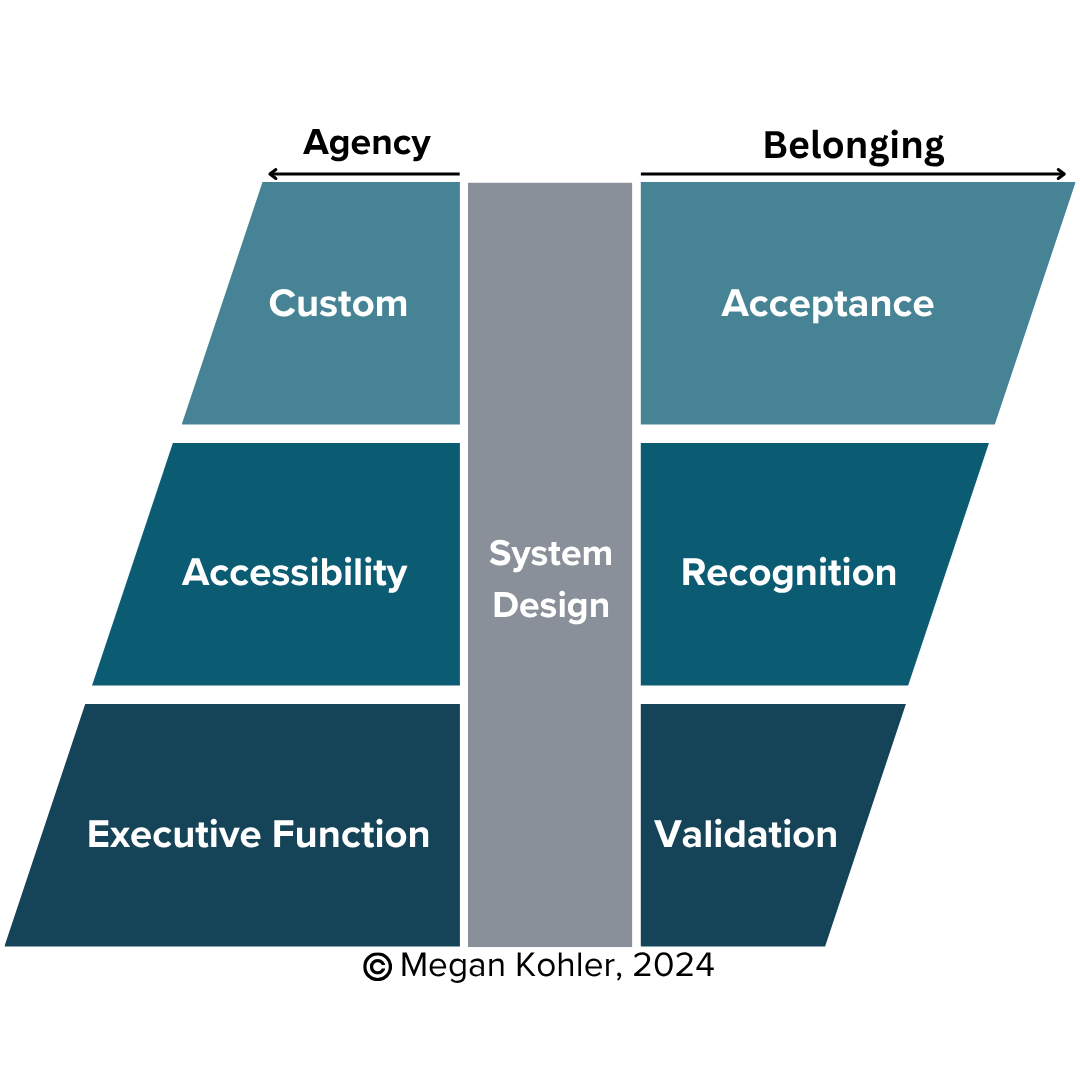
We often approach accessibility through standards, accommodations, and compliance. Those things matter, but neurodivergent learners invite us to consider a broader question: What if the difficulty is not located entirely within the learner? What if some of it is produced by how we design courses, communicate expectations, measure participation, and define success?

A course may technically be accessible while still demanding an exhausting amount of interpretation. Learners might encounter unclear instructions, inconsistent layouts, unnecessary time pressure, sensory overload, rigid participation requirements, or assignments that measure executive functioning as much as subject knowledge.

This challenges us to move beyond asking whether students can access our courses. We also need to ask what our courses require students to overcome before meaningful learning can begin.

At the same time, there is no single neurodivergent learner. A design decision that supports one person may create friction for another. More structure can provide security, but too much can feel restrictive. More choice can create agency, but it can also create decision fatigue. Recorded lectures may offer flexibility while introducing new difficulties with attention and processing.

There may not be one perfectly inclusive design. The goal may be to create thoughtful pathways that give learners greater clarity, flexibility, and control without leaving them to assemble the learning experience on their own.

Productive Challenge or Unnecessary Difficulty?

The conversation also made me think about Vygotsky’s concept of the zone of proximal development. This is the space between what a learner can accomplish independently and what becomes possible with appropriate guidance and support.

In education, we sometimes assume that difficulty is evidence of rigor. But not every difficulty contributes to learning. A student may be capable of engaging deeply with complex ideas while struggling with ambiguous directions, rigid time limits, sensory demands, or the executive functioning required to manage several overlapping tasks. These barriers can push a learner outside a productive learning zone without increasing the intellectual value of the experience.

This raises an important design question: Are we challenging students through the substance of what they are learning, or through the conditions we have constructed around that learning?

For neurodivergent learners, scaffolding might include predictable course structures, models of completed work, opportunities to practice before being evaluated, explicit explanations of expectations, flexible ways to participate, or tools that support planning and processing.

These supports do not remove rigor. They can make the intended rigor more reachable by directing the learner’s effort toward the knowledge or skill the course is meant to develop.

The zone of proximal development also reminds us that appropriate support cannot be entirely standardized. The distance between independence and supported possibility will differ from one learner to another. It may also change across tasks, environments, and moments in a student’s life.

Designing for that variability requires more than adding a fixed collection of accommodations. It requires learning environments that help students recognize what support they need and access it without stigma.

Designing With Learners

Another important consideration is the difference between designing for neurodivergent learners and designing with them.

It is easy for educators and instructional designers to make assumptions about what students need. Even well-intentioned assumptions can reduce people to diagnoses or generalized profiles. Listening, testing, and inviting learners into the design process can reveal barriers that experts may never notice.

However, this creates another responsibility. We should not expect neurodivergent students to repeatedly disclose personal information, represent an entire community, or educate the institution without recognition and support. Meaningful participation must be invited in ways that protect privacy and respect the value of students’ contributions.

Questions I Am Still Considering

The conversation left me with several questions:

  1. Are we challenging students through the substance of the learning, or through unnecessary barriers created by our course design?
  2. How can we distinguish productive struggle within a learner’s zone of proximal development from difficulty caused by an inflexible learning environment?
  3. Which course practices measure actual learning, and which primarily measure executive functioning, processing speed, social comfort, or tolerance for ambiguity?
  4. How can we design with neurodivergent learners without requiring them to disclose personal information or repeatedly educate the institution?
  5. Who gets to define what meaningful participation, engagement, and success look like?

That final question feels especially important. In education, we can unintentionally privilege the learner who responds quickly, speaks comfortably in groups, maintains eye contact, processes information in familiar ways, and demonstrates attention in visible forms. When those behaviors become proxies for engagement, we risk misunderstanding students whose learning is real but expressed differently.

Designing for neurodivergent learners is not about lowering expectations. It is about becoming more precise about which expectations genuinely serve learning. It asks us to preserve meaningful challenge while removing friction that contributes little to the intended outcome.

Perhaps rigor should not be measured by how much difficulty a student can endure independently. A better measure may be the depth of learning students can reach when challenge and support are intentionally designed to work together.

This work requires more than adding accommodations after barriers appear. It requires curiosity about the assumptions embedded in our courses and humility about how much we still need to learn.

Perhaps the most useful starting point is not, “How do we help neurodivergent students succeed in the courses we have designed?”

It may be, “What can neurodivergent learners teach us about designing better learning environments for everyone?”

The Future of AI Voices: A Story, A Shock, and A Question

Um. Hi. Yeah, it’s me. It’s been a while, I know. A lot has happened.

So, where to begin?

How about a quick story—something that felt strangely destined to happen and still has me questioning its implications for humanity?

Melodramatic much?

Welcome to the brain of Dave Goodrich.

But I digress.

A Throwback to the Amiga 500

Commodore Amiga 500, 16-bit computer (1987)

When I was about the age of my oldest son, Gibson—who’s 14 and about to enter high school—someone gifted our family an Amiga 500. We had no clue what it was, so by default, it became mine.

One of its coolest features? Text-to-speech. I could type something, and the computer would read it back to me. Mind. Blown. That moment sparked a lifelong fascination with speech synthesis.

Since then, I’ve used text-to-speech (TTS) technology almost daily for nearly two decades. It’s been a game-changer for my reading habits, my studies, and my ability to consume content on the go.

A few of my go-to tools:

  • Apple products (built-in screen readers)
  • Voice Dream (a fantastic mobile app for reading PDFs, articles, and books)
  • Speech Central (another great TTS app)

But this week, I had an experience that shook my assumptions about AI voices.

A Conversation That Changed Everything

I was having lunch at MSU’s library when I overheard two people engaged in a deep, heartfelt conversation. The way they laughed, paused, and responded to each other—it was something only humans could do. Right?

I thought to myself:

“There is no way AI voices will ever capture this kind of emotional nuance.”

Two hours later, I stumbled upon a video of a guy chatting with an AI-generated voice on a website called Sesame.com.

I couldn’t believe my ears.

The AI’s voice wasn’t just realistic—it had tone, pacing, and personality. It sounded… human.

Then, my colleague Jay mentioned that you can upload PDFs to Notebook.LM and generate an AI-voiced podcast of the content. Curious, I took the terms of service from Sesame.com, fed them into Notebook.LM, and—boom—I had a surprisingly engaging podcast about terms of service.

Seriously. It was interesting. It was entertaining.

And it got me thinking…

What Happens Next?

  • How does this technology make you feel?
  • How could AI-generated voices be used for good?
  • How could they be misused?
  • How do we embrace innovation while protecting ourselves from its risks?

I don’t have all the answers. But I do know this—things are changing fast, and we need to pay attention.

What do you think?

Just Another Dave: Unpacking Copyright in Podcast Episode 001

just another dave…

Welcome to the very first episode of “Just Another Dave,” a podcast that explores the complex and often perplexing world of copyright. A special thanks to Tracy Balduzzi, a people connector and aspiring world traveler from Syracuse University who I met last week at OLC Accellerate in Washington D.C. and who encouraged me to do this. I honestly wouldn’t have without her nudging. So, thank you. In this inaugural episode, we delve into the age-old wisdom of “nothing new under the sun” and examine how copyright intersects with our quest for knowledge and creativity.

Episode 001 Outline

Nothing New Under the Sun

I start by contemplating the ancient wisdom of Ecclesiastes 1:9, which reminds us that there is “nothing new under the sun.” This timeless concept lays the foundation for our discussion on copyright, where the old meets the new.

Re:mix Assignment

Reflecting on my recent experiences in school, I discuss the “re:mix assignment,” wondering if I should be taking courses I have taught before. I’m wondering about the importance of honesty about my learning journey being key as I explore the evolving landscape of copyright. I resonate with Ecclesiastes 1:18, which warns that “the more knowledge, the more grief.”

The Internet’s Own Boy

In this section, I link copyright to the story of “The Internet’s Own Boy,” underlining the significance of intellectual property and how knowledge can sometimes bring misery.

Imposter Syndrome

I explore the concept of imposter syndrome in the context of copyright, discussing the challenges of individuality, standing out in the world, and the multiplicity of ideas that share the same name. I’m pondering the age-old questions: “Who am I?” and “Where did I come from?” and “Where am I headed?”

Artificial Intelligence

I begin a very brief dive into the questions raised when we explore the implications of artificial intelligence on copyright and intellectual property.

All Things New

I wrap up by reflecting on the idea of singing “to the Lord a new song” and the potential for innovation and change in the realm of copyright.

Bob Dylan

Finally, I conclude with an inspirational Bob Dylan video that echoes the themes of creativity and originality in the world of music and art.

Conclusion:
Join me on this intellectual journey as I embark on “Just Another Dave.” In this podcast, I’ll explore the intersections of copyright, education, and technology, drawing on timeless wisdom, modern insights, and thought-provoking discussions. Stay tuned for future episodes that promise to be as honest and raw as they are entertaining.

Green Days

For months now, I have been trying to establish a new morning routine.

Kermit the Frog
Kermit The Frog Graphics free image from Pixy.org

Today is a green day

Allow me to explain…

For months now, I have been trying to establish a new morning routine. I’ve always struggled with creating new routines and especially ones in the morning. I like to sleep. A lot.

Some people who struggle with depression and anxiety experience nights of insomnia. Others, like me, have a difficult time getting out of bed to face the day and just want to sleep all the time. As I mentioned yesterday, this has been my challenge now for over a year.

This new morning routine has been planned and designed to combat my obsession with sleep as an unhealthy coping mechanism to my mental health. The challenge has been in execution.

So, I resolved for 2021 that I would get more serious about it and begin tracking daily which of the morning routine items I had accomplished for that day. If I get all of the items checked off, I highlight the entire row in a tracking spreadsheet bright green. It is very satisfying.

And yet, it is January 18th and I have only 4 green days. Today was one of them. Green days are objectively better than non-green days. There is something about waking up early and exercising right away that sets a whole tone on the day ahead in ways that are unmatched by anything else. Still, getting up to my alarm at 6am on these cold January mornings is a bear.

A few days ago I bought an app on my iPhone called “Alarmy” which gives you certain missions to accomplish in order to keep the alarm from continuing to ring. There are things like math problems to do, quotes to type out, memory games to play, numbers of steps to take, shaking the phone hard for a certain amount of time, and others.

This morning, I tried a new one. It is a picture taking mission. So, to set it up I took a picture of the water spicket on my fridge so that when the alarm goes off, I have to walk to my kitchen in a certain amount of time and take that same picture or my alarm will continue to ring. I think it helped get me moving right away and put me right where I needed to be to begin the day with my first routine item which is to drink a large glass of water right when I wake up. Something about it put me right in motion to continue on with the rest of my routines for the morning. Hopefully, it will again tomorrow and the day after… and the day after that…

It may not be easy being green, but green days are the best days.

My soundtrack for the occasion is this YouTube video of Green Day’s American Idiot Album as instrumental only which makes it easier for me to work to.

My Mental Health Journey

Some of you may know me and the journey I have been on in the past year or so. Others of you don’t. I wanted to begin a new blog series today as a way to share more openly about what I have been experiencing in an effort to connect with people who may be up against similar challenges.

There is no easy way for me to begin. In the latter part of 2019 and all of 2020, I have been on an uphill battle with largely debilitating depression. I have made a lot of progress, but I am not out of the woods yet.

This is not my first go-around with mental health. I’ve spoken publicly before about my history with the disease. But this latest encounter has been by far the most excruciating. I will go into more detail in later posts about the events that led up to this episode, but my hope is to make each of the posts in this series relatively short with a focus on tracking my current progress I am making day to day and week to week.

The one thing I have learned over time is that I definitely can’t recover well if I attempt to do it on my own.

Thank you for following along with me.

My wife is a giver.

Lindsay in front of a Christmas tree.

She has been for as long as I’ve known her.

But 2020 made this more clear than ever.

Right now, in our garage, she has organized volunteers in our neighborhood to be an assembly line for creating Christmas luminaires that will be distributed throughout the block to be lit for Christmas Eve.

This is the kind of thing Lindsay likes to do.

And people come out of the woodwork and come alive to help her in it.

This morning, just like every Sunday morning for the past few weeks since we have been on another lockdown, she organized another game and Christmas activity for the boys and girls in our neighborhood who show up on our front lawn to participate.

For over a month, Lindsay has been having us sit down together as a family after dinner to work on Christmas carols together.

This was so that yesterday, we would be able to meet up with a long time family friend in her hometown to sing to him and to fellowship together over hot cocoa.

Every day, I am amazed by my wife and her love for our boys and for me.

She daily helps them get ready for school, prepares meals, helps them with their homework, has them do their chores, and gets them ready for bed all while being a dedicated mother, worker, and volunteer at their school, in our community and at our church.

These are just a few of the things she has done in recent weeks that have put a smile on people’s face in the midst of the ongoing pandemic.

And she does it out of the sheer joy and love that is in her heart.

I just wanted to take a moment and put a spotlight on Lindsay to say how much she means to me and to recognize her for the saint and the inspiration that she truly is to so many of us.

Thank you, Lindsay.

We love you!

A Rangerdavie Reflection on OLC Innovate 2019:

“Imposter Syndrome was the focus of one of the last sessions I attended and I have never been to a conference presentation anything like it in my life.”

Moving Mountains in Digital, Blended, and Online Learning

Picture of the Rocky Mountains from Dillan, Colorado.

What a conference. This year, OLC Innovate was in the beautiful city of Denver, Colorado. My colleague (curriculum theorist extraordinaire, Dr. Michael Lockett) and I decided to fly down a couple of days before the conference began to get in some slopes at Arapahoe Basin.

During the flight down, I began to experience subtle symptoms of a strange sickness coming on. Things just kept getting worse and worse as we drove higher and higher to the elevated city of Dillan, Colorado. I think it was the combination of the bug I was coming down with added with the complications of elevation sickness. These both compounded with an inability to drink coffee (which is always my sure sign of illness) that left me bedridden all day Monday.

Thankfully, my aches and chills were beginning to slightly subside on Tuesday morning and I was able to join Michael at Loveland ski resort. The powder is where it is at, folks. We had amazing weather and incredible landscape scenery views of the beautiful Rocky Mountains.

After all the fun, it was then time to get down to business and get our conferencing on.

The rest of this post is a reflection on the conference experience for me this year.

The more you know, the sadder you are.

Solomon said something like that in the book of Ecclesiastes, right?

Well, this has been a truth for me and especially in this past year beginning in a Ph.D. program. I knew going into it that I would be needing to confront some of my long-held assumptions and that I had some unlearning to do in order to open myself up to new learning. It is painful. I imagine it is like preparing to run a marathon, although, I’ve never done such a thing.

Thankfully, I’m not going it alone. I have an incredible network of support around me. Doing this venture is on behalf of a bigger cause than just my own growth and development, but hopefully more in-line with service to a public good. Or maybe I’m just a pitiful glutton for knowledge and disillusionment. Either way, I know good can come of this in ways I am unable to currently imagine.

One thing I didn’t anticipate being able to continue to participate in has been professional conferences I’ve been involved in during recent years. Somehow, here I am in Denver, Colorado at the OLC Innovate conference where I’ve been able to contribute nominally to three different ‘emerging ideas’ sessions which are my favorite now. Other than that, my involvement in the conference has been that of listening to ideas, connecting with new folks in the field, and continuing to challenge my own current understanding and assumptions I hold in this work.

I’ll be honest here that in recent years I’ve begun to question notions of ‘best practices’ and other lofty claims of the latest innovative trends on the rise in today’s market-driven economy. So much so that I nearly skipped out on yesterday’s keynote. I assumed it would be another voice in the crowd clamoring to carefully craft in as many buzz-words as possible in a talk. I’ve come to loathe attempts at getting more folks on an ‘innovation’ band-wagon without critically slowing down to ask harder questions lurking behind the latest silicon shine.

Dr. Tressie McMillan Cottom speaking at OLC Innovate.

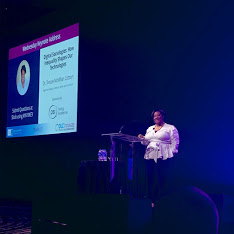
But thankfully I am attending this conference with a whole host of brilliant Spartans. With them, I decided to sit in on the “Digital Sociologies: How Inequality Shapes Our Technologies” keynote. I’m glad I did. Huge praise to the OLC Innovate conference chairs this year (Clark & Ben) who brought in the very voice we needed to hear in our community. I had known through passing word of Dr. Tressie McMillan Cottom’s work and had one of her books on my long ‘to-read’ list, but I hadn’t realized she was going to be the keynote at the conference this year. I hadn’t yet known her by name. Her work is really important and I’m thrilled that I was able to be introduced to it through her talk before diving deeper into her books in the near future. She has compelling inquiries for us to grapple with in the world of educational technology in what she calls ‘lower-education’ which was the title of one of her earlier books that caught my attention. These inquiries are rooted in experience and built upon decades of research. They are interrogating some of the deeper societal ills and philosophical underpinnings of our postsecondary education cultures at large. The provocations are rightly holding us to account for our role in changing the world in which we live and in which future generations are entering into. I hope that keynote was a beginning to further conversations we can continue to revisit and grapple with in years ahead.

Speaking of conversations, I had the pleasure this year of getting involved in the Ranger program at the conference that began for the first time last year in Nashville. Here, we are able to connect first-time attendees of the conference to those who have attended before as a way to catalyze new connections and orient folks to the ins and outs of the overall mapped out experiences designed for participants. I enjoyed pretending to know what I was talking about and meeting new folks who would often express that they hadn’t attended a conference that was so personable like this in the past. I fondly remember my first time attending and experiencing these same OLC joys that I continue to love today.

For example, as I have reflected on previously, my foray into the beautifully networked connections that happen at OLC conferences is in large due to my luck of getting to know and work with the notoriously networked Dr. Jessica Knott. It was at ET4Online in Dallas that I first was able to meet folks like Dr. Michelle Pacansky-Brock who I had adored her educator development work from afar for years prior. Others I was able to meet in person like Dr. Chuck D. Dziuban who I had only known from his many years of research on blended learning and some random virtual encounters because of his notoriously prolific collaborative tendencies with folks all over the world.

Group of colleagues enjoying a night out on the town in Denver.

I also began new friendships and professional network connections that would turn out to be the most important for my growth and learning for my career to date. For instance, my Spartan colleagues and I have met and collaborated now with amazing people like Angela Gunder, Ben Scragg, Clark Shah-Nelson, Kate Miffitt, Dr. John Stewart, Keegan Long-Wheeler, Dr. Steven R. Crawford, Dr. Angela Gibson, Dr. Ann Musgrove, Adam Nemeroff, Frank Tomsic, Rick Franklin, Janet Smith, Michael Griffith, Venessa Ball, Dr. Patrice Torcivia Prusko, Shereen Twum-Barimah, Steve Merlo, Dr. Laura Pasquini, Phylise Banner, Dr. Rachael Neimer, Dr. Matt Crosslin, Jessie Stommel, Dr. Chris Gilliard, Taylor Kendal, Dr. Ryan Straight, Dr. A. Michael Berman, and so many others…

Each of these people listed here and many others who are not (but could easily add their name here through multiple connections that intersect) have all influenced my thinking and growth as a learner, educator, and professional (I try to be anyway). If I let imposter syndrome get out of hand, I can easily worship these folks and wonder how it is that I could even audaciously list them as networked influencers for me. But I know that the reality is that they are all honest, hard-working, passionate, dedicated, thoughtful, silly, curious, resilient, and compassionate educators in the world just like me. They probably also make mistakes, spill coffee, yell at their kids, get stuck in traffic, and wear mismatched clothing as I do. Although, I may have the upper-hand at these latter claims. Who’s keeping score, though?

Ben Scragg speaking during a campfire chat on the OLC Innovate big stage.

When it comes down to it, we are all working together for the same common values, goals, aspirations, visions of the future that includes justice, equity, compassion, and more human-centered postures toward a better tomorrow. This year, I really appreciated Ben Scragg’s campfire talk on just beginning and sharing without things needing to be perfect. Also, Joshua Steele’s emphasizing a Slido question we weren’t answering the day prior on the topic of online learning being supposedly opportunistic for first-generation and low-income students and yet how we make sense of how the success rates are so dismal. What are we doing wrong?

Imposter Syndrome was the focus of one of the last sessions I attended and I have never been to a conference presentation anything like it in my life. My hands were sweating profusely during the whole session. This may be my new metric for conference session success because it indicated to me that there were courageous, honest, vulnerable, and difficult things being talked about out in the open. At times, it felt like an AA meeting. I truly believe that the most important work we do in education will look and feel much like this. True change always begins in supportive communities reaching for collective and individual salvation from the vices and lies we can fall prey to. This is similar in our professional lives as it is to our personal lives (if such a divide truly exists or is an illusion, I’m not entirely sure).

Some of the best developments at OLC in recent years have been the inclusion of slow flow yoga with spiritual guru Janet Smith in the mornings and meditation & mindfulness sessions with life coach Clark Shah-Nelson.

Sessions that were captivating and well worth my time (there are many more that I’m sure I would be listed if I had been able to be in multiple places at once) included:

  • Clusters & Hexes Creating Educator Pipelines with Online Modules: Reimagining Educator Prep from Community to Classroom: Hyperlink.
  • Thursday Evening Campfire Gathering: Night in Denver: Hyperlink.
  • Exploring Alternative Learning Design Approaches: Hyperlink.
  • Sisyphus & Squad Goals: Perpetual Becoming, With a Lot of Help From My Friends: Hyperlink.

Lastly, I’d like to thank my kind and talented colleagues who allowed me to contribute to the following emerging ideas sessions.

  • The Syllabus Matters (More than you Think): Reconceptualizing the Aesthetic and Educative Properties of a Core Curricular Text: Hyperlink.
  • The Journey Towards Culture Shift Through an Educator Learning Community (ELC): The #iteachmsu Commons: Hyperlink.
  • Social Media UnderFire: Questions of Cognition, Literacy, and Online Learning: Hyperlink.

What a week! Now, back to the good work in the great state of Michigan. So well, Denver. You’ve been lovely and delightful, yet again. Chicago, I am looking forward to seeing you next year around this time, I hope!

The Music Industry of Academic Publishing

There are parallels between what is currently happening in academic publishing to the array of digital disturbances brought upon recording production houses. These similarities are noteworthy for improving understanding of academic scholarship in the digital age.

It is interesting to be entering into the field of scholarship in an era of major disruption to the enterprise. It was about fifteen years ago I was venturing into the music industry in a similar kind of fashion. There are parallels between what is currently happening in academic publishing to the array of digital disturbances brought upon recording production houses. These similarities are noteworthy for improving understanding of academic scholarship in the digital age.

I was pleasantly surprised when I attended this past week’s “Open Access after Paywall: A Panel Discussion on Scholarly Publishing” in MSU’s main library, where discussants drew on such analogies. In Kathleen Fitzpatrick’s closing remarks, she charged all in attendance to imagine with her what a model of scholarship might look like resembling services like Spotify, Apple Music, or other new forms of mainstream media that have taken shape in the age of digitization. Of course, the internet and Open Access movements have resulted in a diverse array of publication and recording options where nearly anyone can grab a microphone or webcam and start developing audiences on the web. Similarly, the astronomical explosion of online journals and publications have provided many different options for scholars to weigh when publishing their work. Many have decried the eroding potential this could have on the businesses of publication and hence the quality of scholarship. And yet the music industry has changed dramatically in the past ten to twenty years and some argue for the better.

Take an example from the experiences of a musician named David Bazan (Pedro the Lion) who I’ve come to deeply appreciate over the past twenty years. David continues to be a far lesser known recording artist than the likes of Radiohead or Katy Perry who can claim world-wide appeal. Yet, he has continually developed a robust and dedicated fan base. Bazan used to tour and play with the band Death Cab for Cutie who went on to ‘make it big’ in the industry, but he describes a negative influence mainstream music had on their craft despite improved production budgets. In fact, Bazan maintains that artists who don’t ‘sell out’ and continue to stay true to a more intimate audience are far more interesting despite having to just scrape by for living expenses.

I had the chance to meet David at a living room house show organized by fans here in Michigan. I remember going to a bar with him after the show that evening and hearing him discuss his concerns with Spotify as an online distribution platform he claimed was not paying artists like him their fair due in royalties. It was only a few short years later that I encountered a distinct change of heart he had to the platform to the point where he embraced Spotify while enjoying his own resulting discovery of new music. I have to wonder if scholars will experience similar resistance and eventual acceptance to emerging forms of academic scholarship in the age of digitization.

Just write…

Makena with her really cool FreeWrite

Recently, my friend Makena Neal shared with me a super neat gadget she acquired for focused writing. It is called a FreeWrite. Essentially, it has a WiFi connection for the sole purpose of sending what you write up to the cloud. Other than that, it is geared for distraction free writing like we used to have on typewriters, but this thing comes with the affordances of having the writing in digital. Plus, the monitor is e-ink technology which basically means it is like reading ink on paper compared to reading on pixels of an LCD screen. 

The timing of her sharing this with me was so interesting because the weekend prior I had been doing extensive Googling on ways to convert my Kindle to a distraction free and eye friendly way of working on writing. How cool is a FreeWite to be designed for exactly this?

This sent me further into an online hunt for ways to better digitally write offline.

So, this past weekend I decided to do some searching on similar kinds of gadgets that wouldn’t break the bank and I was pleasantly delighted to stumble upon the AppleSmart 3000.

That’s right folks. I’m moving up in the world. I just upgraded to a brand new (used) smart device.

My 20 year old new nerdy writing tool

It doesn’t connect to the internet. It runs on 3 AA batteries for up to 700 hours. When I am done typing, I can connect it to a computer to send my writings there. Yes, it is 20+ years old and it feels like my 1998 typing class keyboard in high school. Still, I can’t even begin to tell you how gritty this makes me. Finally, I can write off the grid in a digital format without having the distractions of email, google, slack, twitter, texts and basically all the things that are so good at interrupting streams of thought that happen only while one can write. 

Writing with distractions is nearly impossible to do. For me, trying to write around the noise of other people or of social media is like trying to talk to someone while also talking to someone else on the phone. Now I am one step closer to writing distraction free. Bonus: it cost me $30.

Take that, internet.

The children of the 80s and 90s are still alive and kicking the truly smart technologies.