A Rangerdavie Reflection on OLC Innovate 2019:

“Imposter Syndrome was the focus of one of the last sessions I attended and I have never been to a conference presentation anything like it in my life.”

Moving Mountains in Digital, Blended, and Online Learning

Picture of the Rocky Mountains from Dillan, Colorado.

What a conference. This year, OLC Innovate was in the beautiful city of Denver, Colorado. My colleague (curriculum theorist extraordinaire, Dr. Michael Lockett) and I decided to fly down a couple of days before the conference began to get in some slopes at Arapahoe Basin.

During the flight down, I began to experience subtle symptoms of a strange sickness coming on. Things just kept getting worse and worse as we drove higher and higher to the elevated city of Dillan, Colorado. I think it was the combination of the bug I was coming down with added with the complications of elevation sickness. These both compounded with an inability to drink coffee (which is always my sure sign of illness) that left me bedridden all day Monday.

Thankfully, my aches and chills were beginning to slightly subside on Tuesday morning and I was able to join Michael at Loveland ski resort. The powder is where it is at, folks. We had amazing weather and incredible landscape scenery views of the beautiful Rocky Mountains.

After all the fun, it was then time to get down to business and get our conferencing on.

The rest of this post is a reflection on the conference experience for me this year.

The more you know, the sadder you are.

Solomon said something like that in the book of Ecclesiastes, right?

Well, this has been a truth for me and especially in this past year beginning in a Ph.D. program. I knew going into it that I would be needing to confront some of my long-held assumptions and that I had some unlearning to do in order to open myself up to new learning. It is painful. I imagine it is like preparing to run a marathon, although, I’ve never done such a thing.

Thankfully, I’m not going it alone. I have an incredible network of support around me. Doing this venture is on behalf of a bigger cause than just my own growth and development, but hopefully more in-line with service to a public good. Or maybe I’m just a pitiful glutton for knowledge and disillusionment. Either way, I know good can come of this in ways I am unable to currently imagine.

One thing I didn’t anticipate being able to continue to participate in has been professional conferences I’ve been involved in during recent years. Somehow, here I am in Denver, Colorado at the OLC Innovate conference where I’ve been able to contribute nominally to three different ‘emerging ideas’ sessions which are my favorite now. Other than that, my involvement in the conference has been that of listening to ideas, connecting with new folks in the field, and continuing to challenge my own current understanding and assumptions I hold in this work.

I’ll be honest here that in recent years I’ve begun to question notions of ‘best practices’ and other lofty claims of the latest innovative trends on the rise in today’s market-driven economy. So much so that I nearly skipped out on yesterday’s keynote. I assumed it would be another voice in the crowd clamoring to carefully craft in as many buzz-words as possible in a talk. I’ve come to loathe attempts at getting more folks on an ‘innovation’ band-wagon without critically slowing down to ask harder questions lurking behind the latest silicon shine.
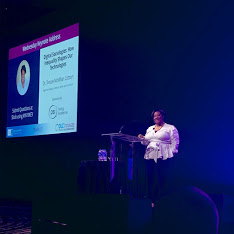
Dr. Tressie McMillan Cottom speaking at OLC Innovate.

But thankfully I am attending this conference with a whole host of brilliant Spartans. With them, I decided to sit in on the “Digital Sociologies: How Inequality Shapes Our Technologies” keynote. I’m glad I did. Huge praise to the OLC Innovate conference chairs this year (Clark & Ben) who brought in the very voice we needed to hear in our community. I had known through passing word of Dr. Tressie McMillan Cottom’s work and had one of her books on my long ‘to-read’ list, but I hadn’t realized she was going to be the keynote at the conference this year. I hadn’t yet known her by name. Her work is really important and I’m thrilled that I was able to be introduced to it through her talk before diving deeper into her books in the near future. She has compelling inquiries for us to grapple with in the world of educational technology in what she calls ‘lower-education’ which was the title of one of her earlier books that caught my attention. These inquiries are rooted in experience and built upon decades of research. They are interrogating some of the deeper societal ills and philosophical underpinnings of our postsecondary education cultures at large. The provocations are rightly holding us to account for our role in changing the world in which we live and in which future generations are entering into. I hope that keynote was a beginning to further conversations we can continue to revisit and grapple with in years ahead.

Speaking of conversations, I had the pleasure this year of getting involved in the Ranger program at the conference that began for the first time last year in Nashville. Here, we are able to connect first-time attendees of the conference to those who have attended before as a way to catalyze new connections and orient folks to the ins and outs of the overall mapped out experiences designed for participants. I enjoyed pretending to know what I was talking about and meeting new folks who would often express that they hadn’t attended a conference that was so personable like this in the past. I fondly remember my first time attending and experiencing these same OLC joys that I continue to love today.

For example, as I have reflected on previously, my foray into the beautifully networked connections that happen at OLC conferences is in large due to my luck of getting to know and work with the notoriously networked Dr. Jessica Knott. It was at ET4Online in Dallas that I first was able to meet folks like Dr. Michelle Pacansky-Brock who I had adored her educator development work from afar for years prior. Others I was able to meet in person like Dr. Chuck D. Dziuban who I had only known from his many years of research on blended learning and some random virtual encounters because of his notoriously prolific collaborative tendencies with folks all over the world.

Group of colleagues enjoying a night out on the town in Denver.

I also began new friendships and professional network connections that would turn out to be the most important for my growth and learning for my career to date. For instance, my Spartan colleagues and I have met and collaborated now with amazing people like Angela Gunder, Ben Scragg, Clark Shah-Nelson, Kate Miffitt, Dr. John Stewart, Keegan Long-Wheeler, Dr. Steven R. Crawford, Dr. Angela Gibson, Dr. Ann Musgrove, Adam Nemeroff, Frank Tomsic, Rick Franklin, Janet Smith, Michael Griffith, Venessa Ball, Dr. Patrice Torcivia Prusko, Shereen Twum-Barimah, Steve Merlo, Dr. Laura Pasquini, Phylise Banner, Dr. Rachael Neimer, Dr. Matt Crosslin, Jessie Stommel, Dr. Chris Gilliard, Taylor Kendal, Dr. Ryan Straight, Dr. A. Michael Berman, and so many others…

Each of these people listed here and many others who are not (but could easily add their name here through multiple connections that intersect) have all influenced my thinking and growth as a learner, educator, and professional (I try to be anyway). If I let imposter syndrome get out of hand, I can easily worship these folks and wonder how it is that I could even audaciously list them as networked influencers for me. But I know that the reality is that they are all honest, hard-working, passionate, dedicated, thoughtful, silly, curious, resilient, and compassionate educators in the world just like me. They probably also make mistakes, spill coffee, yell at their kids, get stuck in traffic, and wear mismatched clothing as I do. Although, I may have the upper-hand at these latter claims. Who’s keeping score, though?

Ben Scragg speaking during a campfire chat on the OLC Innovate big stage.

When it comes down to it, we are all working together for the same common values, goals, aspirations, visions of the future that includes justice, equity, compassion, and more human-centered postures toward a better tomorrow. This year, I really appreciated Ben Scragg’s campfire talk on just beginning and sharing without things needing to be perfect. Also, Joshua Steele’s emphasizing a Slido question we weren’t answering the day prior on the topic of online learning being supposedly opportunistic for first-generation and low-income students and yet how we make sense of how the success rates are so dismal. What are we doing wrong?

Imposter Syndrome was the focus of one of the last sessions I attended and I have never been to a conference presentation anything like it in my life. My hands were sweating profusely during the whole session. This may be my new metric for conference session success because it indicated to me that there were courageous, honest, vulnerable, and difficult things being talked about out in the open. At times, it felt like an AA meeting. I truly believe that the most important work we do in education will look and feel much like this. True change always begins in supportive communities reaching for collective and individual salvation from the vices and lies we can fall prey to. This is similar in our professional lives as it is to our personal lives (if such a divide truly exists or is an illusion, I’m not entirely sure).

Some of the best developments at OLC in recent years have been the inclusion of slow flow yoga with spiritual guru Janet Smith in the mornings and meditation & mindfulness sessions with life coach Clark Shah-Nelson.

Sessions that were captivating and well worth my time (there are many more that I’m sure I would be listed if I had been able to be in multiple places at once) included:

  • Clusters & Hexes Creating Educator Pipelines with Online Modules: Reimagining Educator Prep from Community to Classroom: Hyperlink.
  • Thursday Evening Campfire Gathering: Night in Denver: Hyperlink.
  • Exploring Alternative Learning Design Approaches: Hyperlink.
  • Sisyphus & Squad Goals: Perpetual Becoming, With a Lot of Help From My Friends: Hyperlink.

Lastly, I’d like to thank my kind and talented colleagues who allowed me to contribute to the following emerging ideas sessions.

  • The Syllabus Matters (More than you Think): Reconceptualizing the Aesthetic and Educative Properties of a Core Curricular Text: Hyperlink.
  • The Journey Towards Culture Shift Through an Educator Learning Community (ELC): The #iteachmsu Commons: Hyperlink.
  • Social Media UnderFire: Questions of Cognition, Literacy, and Online Learning: Hyperlink.

What a week! Now, back to the good work in the great state of Michigan. So well, Denver. You’ve been lovely and delightful, yet again. Chicago, I am looking forward to seeing you next year around this time, I hope!

The Music Industry of Academic Publishing

There are parallels between what is currently happening in academic publishing to the array of digital disturbances brought upon recording production houses. These similarities are noteworthy for improving understanding of academic scholarship in the digital age.

It is interesting to be entering into the field of scholarship in an era of major disruption to the enterprise. It was about fifteen years ago I was venturing into the music industry in a similar kind of fashion. There are parallels between what is currently happening in academic publishing to the array of digital disturbances brought upon recording production houses. These similarities are noteworthy for improving understanding of academic scholarship in the digital age.

I was pleasantly surprised when I attended this past week’s “Open Access after Paywall: A Panel Discussion on Scholarly Publishing” in MSU’s main library, where discussants drew on such analogies. In Kathleen Fitzpatrick’s closing remarks, she charged all in attendance to imagine with her what a model of scholarship might look like resembling services like Spotify, Apple Music, or other new forms of mainstream media that have taken shape in the age of digitization. Of course, the internet and Open Access movements have resulted in a diverse array of publication and recording options where nearly anyone can grab a microphone or webcam and start developing audiences on the web. Similarly, the astronomical explosion of online journals and publications have provided many different options for scholars to weigh when publishing their work. Many have decried the eroding potential this could have on the businesses of publication and hence the quality of scholarship. And yet the music industry has changed dramatically in the past ten to twenty years and some argue for the better.

Take an example from the experiences of a musician named David Bazan (Pedro the Lion) who I’ve come to deeply appreciate over the past twenty years. David continues to be a far lesser known recording artist than the likes of Radiohead or Katy Perry who can claim world-wide appeal. Yet, he has continually developed a robust and dedicated fan base. Bazan used to tour and play with the band Death Cab for Cutie who went on to ‘make it big’ in the industry, but he describes a negative influence mainstream music had on their craft despite improved production budgets. In fact, Bazan maintains that artists who don’t ‘sell out’ and continue to stay true to a more intimate audience are far more interesting despite having to just scrape by for living expenses.

I had the chance to meet David at a living room house show organized by fans here in Michigan. I remember going to a bar with him after the show that evening and hearing him discuss his concerns with Spotify as an online distribution platform he claimed was not paying artists like him their fair due in royalties. It was only a few short years later that I encountered a distinct change of heart he had to the platform to the point where he embraced Spotify while enjoying his own resulting discovery of new music. I have to wonder if scholars will experience similar resistance and eventual acceptance to emerging forms of academic scholarship in the age of digitization.

Germination of digital scholarship?

Who knows where this might lead?

Last week, I joined an academic blogging group in the MSU Library’s Digital Scholarship Lab. Today, we have our second meeting. The first was really exciting as I could relate a lot with the other participant’s reasons for joining.

Major themes in that meeting’s conversation revolved around the value that comes from a blogging community for getting ideas out earlier for feedback than what would be possible through traditional publishing channels. There also seemed to be a common theme among us of solidarity. We all want to join this small group of folks to help us each get back to our personal digital scholarship development. Many of us have blog spaces that either have been left dormant for a long time or that were created and never actively utilized.

This group is being led by Dr. Kathleen Fitzpatrick who just came out with her second book last week titled Generous thinking: A radical approach to saving the university. It was a joy to meet Dr. Fitzpatrick last week. I have been reading some of her work in a graduate course I am taking right now called Scholarly communications for the digital age taught by Dr. Steve Weiland in the HALE PhD program I am in. I’m only in the 1st year of courses so far, but am beginning to experiment with dissertation research possibilities.

I’d like to begin getting those ideas out here for broader feedback in the coming posts in weeks ahead. So, if that sounds interesting to you and you would like to nerd out with me here, stay tuned! More to come soon…

Go, go, gadget reckoning…

There was a time when I believed the digital revolution would change everything. Maybe it has. But the changes are not entirely what I thought they would be.

There was a time when I believed the digital revolution would change everything. Maybe it has. But the changes are not entirely what I thought they would be. Looking beyond my own experience, there seems to be a historically emotional cycle of sorts in society – from thrills of technological advancement to crashes of disenchantment. I think back to mankind’s first discovery of fire and imagine the curiosity and excitement joined with fear and terror around new possibilities. Fire produced warmth and prolonged nourishment through the discovery of cooked food. But it also introduced new hazards and possibilities of arson. Or, I think of the invention of the car. I live in Michigan after all. No one would imagine only a little over a century ago that it would be possible to commute on wheels across to distances in minutes, hours, or days that previously took weeks, months, or even years. And yet, this catapulting locomotive innovation has simultaneously introduced a common cause of death today.

It is easy for the excitement around the discovery of what is new to overshadow the introduced risks that accompany technological innovation. This certainly happened when new digital affordances were being introduced to me in the formative years of grade school. Suddenly, my poor handwriting was a challenge of the past. Searching through text for keywords was mesmerizingly instantaneous. Hyperlinks allowed for endless rabbit holes of learning that flowed through many diverse sources. At the same time, new habits began forming undetected. Namely, my appetite for long form text reading began to diminish. My attention span for even relatively short articles online dwindled. Further, my memory and recall of vast amounts of article bouncing was less distinct than when I was steeped in a book series. I was not fully aware of these shifts. In fact, if someone pointed them out, I may have denied the accusation.

By the time I entered college, one of my professors described me as a “gadget guy.” I took it as a compliment. I had palm pilots, digital cameras, satellite radio devices, and mobile phones all in my pockets or attached to my belt buckles. I entered the classroom fresh out of college as a high school science teacher where I continued my fascination with digital technology affordances for my profession. Still, to this day, I carry and rely on vast amounts of technology as do my children. I’m not going to lie, in many ways I love it. It wasn’t until I began my career as an instructional designer where I started to unmask a dark shadow lurking behind pixels. I read online articles by Nicholas Carr. Maybe they were making me stupid, I’m not sure. But I paid further attention to debates around psychological and cognitive concerns being raised about the ill-effects of multimedia on the human brain. Most of these readings, I found to be amusing and interesting, but I didn’t take them too seriously at first. I brushed many of the debates off as conservative fears trying only to maintain a status quo. I then read a book by Shane Hipps called Flickering Pixels, How Technology Shapes Your Faith. It was here I was introduced to thinking of Marshall McLuhan and some of his controversial statements in the 1950’s and 60’s including his predictions of the future. McLuhan’s descriptions sounded eerily like the present realities we find ourselves in. I interviewed Shane Hipps to learn more.

This was, for me, the beginning of an ongoing reckoning. I find myself daily torn between forces of innovation and nudges of ancient wisdom. Now, if you’ll excuse me, I think I’ll go tweet about it.

Just write…

Makena with her really cool FreeWrite

Recently, my friend Makena Neal shared with me a super neat gadget she acquired for focused writing. It is called a FreeWrite. Essentially, it has a WiFi connection for the sole purpose of sending what you write up to the cloud. Other than that, it is geared for distraction free writing like we used to have on typewriters, but this thing comes with the affordances of having the writing in digital. Plus, the monitor is e-ink technology which basically means it is like reading ink on paper compared to reading on pixels of an LCD screen. 

The timing of her sharing this with me was so interesting because the weekend prior I had been doing extensive Googling on ways to convert my Kindle to a distraction free and eye friendly way of working on writing. How cool is a FreeWite to be designed for exactly this?

This sent me further into an online hunt for ways to better digitally write offline.

So, this past weekend I decided to do some searching on similar kinds of gadgets that wouldn’t break the bank and I was pleasantly delighted to stumble upon the AppleSmart 3000.

That’s right folks. I’m moving up in the world. I just upgraded to a brand new (used) smart device.

My 20 year old new nerdy writing tool

It doesn’t connect to the internet. It runs on 3 AA batteries for up to 700 hours. When I am done typing, I can connect it to a computer to send my writings there. Yes, it is 20+ years old and it feels like my 1998 typing class keyboard in high school. Still, I can’t even begin to tell you how gritty this makes me. Finally, I can write off the grid in a digital format without having the distractions of email, google, slack, twitter, texts and basically all the things that are so good at interrupting streams of thought that happen only while one can write. 

Writing with distractions is nearly impossible to do. For me, trying to write around the noise of other people or of social media is like trying to talk to someone while also talking to someone else on the phone. Now I am one step closer to writing distraction free. Bonus: it cost me $30.

Take that, internet.

The children of the 80s and 90s are still alive and kicking the truly smart technologies.

Loneliness is a Deadly Illusion

I was invited recently to respond to some questions about my PLN from the good folks who put together the Squad Goals Network.

I was invited recently to respond to some questions about my PLN (Professional Learning Network) from the good folks who put together the Squad Goals Network. The questions made me think deeper about the role my PLN has played in my work as an educator for the past 12 years. Ultimately, I believe learning is directly proportional to the depth and quality of one’s own PLN. Read further reflections to their questions below:

Access: Does regular access to other individuals from other institutions and institutional perspectives challenge your definition of access and what it means? If so, how?

Access itself is rooted in the concept of ownership. For instance, I am breathing air currently while sitting in a Wendy’s in Jackson, Michigan. The Wendy’s doesn’t own the air I am breathing, therefore I am not paying for it and I don’t think of it as something I have access to as much as I think of it something available to everyone at anytime and anywhere where our atmosphere reaches. Similarly, I don’t think of my connections to other people that work at other institutions as something I have access to so much as I think is something that I would have a very hard time living without.

I do have a difficult time with the concept of “institutional perspectives.” It simply doesn’t make very much sense to me outside of the context of a common set of values the individuals within an organization have collectively agreed to. How can an institution have a perspective outside of the multiple nuanced perspectives shared within the community of individuals within the institution? And what about the perspectives of those who have been a part of the institution in the past, but no longer officially are. Do they come into play somehow? I think of an institution as a construct that contains a culture of many different people sort-of how I think of my car as a construct that carries me and other passengers from one place to another. I wouldn’t say my car has a perspective so much as I would say it carries people with different perspectives. Does this make sense?

Faculty Satisfaction: How has your participation in the PLN benefitted faculty and colleagues at your home institution?

This might be an interesting question for me to ask of the faculty and colleagues around me. I would hope that my engagement in the PLN has directly benefited those around me by helping them to be connected to intellectual discourse around the ethos of the common work and goals we are all espousing to. If anything, it has challenged their thinking by giving them glimpses into perspectives, practices, failures and successes that can be directly informing our own work. Hopefully, we also have been in the continual practice of giving back in terms of sharing our own learning with our own broader professional learning networks.

Learning Effectiveness: When you reflect on your work, how has meeting and learning from individuals from other institutions and institutional perspectives helped you to clarify or re-define what it means for learning to be effective?

I’ve always understood learning to be a deeply social phenomenon. This is true even in critical aspects of learning that require independent study and reflection. The learning I’ve experienced with and from my PLN has served to clarify for me this truth. It has done so by reminding me of the power of shared experience and storytelling in the context of a community of inquiry as an essential component of my own ongoing professional growth and development. This is reminiscent of any meaningful learning experience I’ve ever encountered. Hopefully, this richly informs my work creating effective learning experience designs.

Scale: Is the PLN scalable and/or replicable by others at other institutions/organizations? If so, how? What challenges do you encounter?

Scalable and replicable are terms that make me queasy. I might reframe this in a way that describes the PLN as a reality encountered already in any effective educational entity. For instance, if someone were ask me if biodiversity is scalable and replicable, I might reply with a pinch of snark by encouraging the asker to open their eyes and look around them. A better question might be what the effects are of monocultures on ecosystem health? Similarly, I fundamentally believe that healthy learning environments are incapable of flourishing without the presence of a healthy community of inquiry being shepherded.

Most challenges I encounter around the concept of PLN development stem from common lethargy regarding the investments needed to make them a reality. You might think of this challenge similarly to how I encounter challenges with staying healthy, fit and in shape. Most of my challenges with these things stem from me lacking the will or discipline to carve out the time and resources needed to habitually be in the practice of various forms of exercise. Similarly, most of my PLN challenges are rooted in a lack of resources devoted to prioritizing my PLN appropriately in the juggling demands of life and work.

Student Satisfaction: Do you feel that your involvement and/or collaboration with the PLN has helped you create better student experiences at at your institution?

Undoubtedly, yes. In fact, if I didn’t benefit in the ways I do from my own PLN, I wouldn’t know the powerful effect it would have on my students. So, I try to encourage and cultivate PLNs for students in ways that are not formally mandated, but that can happen when the right kind of challenges are designed in ways that require learners to navigate them together rather than in isolation. I also try and be as transparent as I can about the positive things I glean on a daily basis from my PLN in terms of having mentors, mentees, sounding boards and critical dialog with folks around the things I am currently dealing with in my educative work or things I am trying to better understand.

It is extremely easy in this work of teaching and learning to fall under the illusive trap of feeling isolated and alone. There is nothing that threatens learning and life more than this deadly illusion. Similarly, there is nothing more opportunistic for learning than to recognize the deeply networked relationships that have always been a constant thread in all of human learning, growth and development. This truth runs deeply throughout history even to the point of a mysterious and little understood notion of collective consciousness.